


GREENEVILLE – Tusculum University students are contributing to the community’s quality of life and gaining hands-on learning as they help build a new exhibit at a local museum.
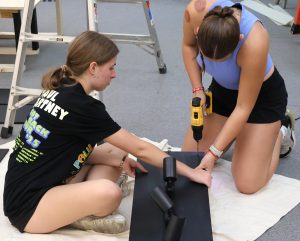
Students AnnaLee Simpson, left, and Kyra Klouzek prepare a lighting track for installation.
As part of a museum studies course, the students and their professor are collaborating with the Greeneville-Greene County History Museum to redevelop a large room to tell the community’s story from the pre-colonization period – as far back as the 1500s – to the Civil War. The students are dedicating Thursday afternoons to serve at the museum, which is seeking to open the exhibit by June.
“This is an excellent project for our students because it teaches them valuable skills they will be able to use in their careers,” said Dr. Peter Noll, professor of public history and museum studies. “We have been discussing the ideas and principles that apply to this project in the classroom, but performing the work really brings what they have studied to life in a meaningful way. Participating in this initiative with a nonprofit organization also reinforces to the students the value of being civically engaged.”
Dr. Noll is a member of the museum’s Board of Trustees, and he also taught Sydney May, co-director/curator, when she was a Tusculum student.
Details about the exhibit
In addition to highlighting some of the people who came through Greene County as long as 500 years ago, the exhibit will discuss the challenges of establishing a county government after the formation of Greene County in 1783 through about 1820. It will also touch on the economy of that period in the county and how it tied into the broader story of America. That will lay the groundwork for an exploration of the Civil War and Greene County’s part followed by an examination of what happens in the community afterward.
“Basically, this exhibit will end at the Civil War and will leave you with the question, ‘Where do we go from here?’” May said. “Then, hopefully in the next couple of years, we’re going to go into the other gallery space and pick up where we left off.”
May said the exhibit, which has been supported by a grant, will have a connection to the other facets of the United States but focus on Greene County.
Tusculum’s work on the project
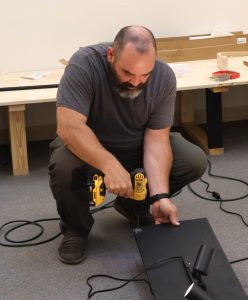
Dr. Peter Noll works on a lighting track.
May and Josh Dacey, co-director/public outreach, completed extensive work to remove items from the exhibit room. Then, in August, Noll developed the plan for the platform that has been constructed in the room for the new exhibit. The students entered the picture when the fall semester began and have taken care of tasks such as installing the new lights, painting the lighting panels, repairing a wall and installing a railing system.
The students are either in the class or are obtaining internship and practicum hours. They will work at the museum for a total of 25 hours.
“Our crew is here to build out the basic frame furniture of the exhibit, and the museum staff will perform all of the major work – developing the story, selecting the objects and completing the label copy and graphics,” Dr Noll said. “We’re here to help.”
Museums generally are not blessed with unlimited resources. The participation of students and Dr. Noll is enabling the Greene County museum to stretch the grant funds, and the knowledge they bring to the project will help produce a professional exhibit, Dr. Noll said.
The students benefit, too, because this project is teaching them the proper way to light an exhibit, for example. They are also learning how to convey information in a three-dimensional space.
“Next semester, we have a museum exhibits course, where students will also be doing this type of work, but they’ll also be doing the planning, the writing and the graphic design pieces,” Dr. Noll said. “With the project in this museum, the students are getting their feet wet and using certain tools for the first time.”
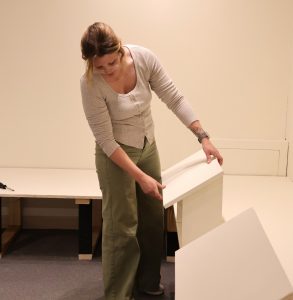
Sydney May installs a reading rail.
During the spring semester, the students will build a unit in the center of the room that will focus on textile production and weaving and feature a loom.
May graduated from Tusculum in 2024 with a bachelor’s degree in history, with a concentration in museum studies. She then went to work for the museum. As a Tusculum alumna, she understands the need for students to obtain practical experience as they pursue their degrees.
When she was a student, May had opportunities to participate in active and experiential learning. She welcomed the students’ work on the new museum exhibit when Dr. Noll broached the idea. She has been pleased with the work the students have performed.
Perspectives from the students
Junior Kyra Klouzek, who is a history major with a concentration in museum studies, said she was interested in participating in the new exhibit because it would help prepare her for working in a museum after graduation.
“This will really help me with knowing the steps I’d have to go through to possibly create an exhibit and run an exhibit and figure out what is best for it,” she said. “I think this project is doing what I was hoping. It’s showing me the elements that it takes to really go in and build an exhibit from scratch. It’s also giving me the experience of working with the tools, the light fixtures and the other materials I need to build everything. It’s teaching me all of the steps that I would need to know in the future about how to go about designing an exhibit in a given space.”
Klouzek’s career goal is to become an archaeologist and work in the field, but this project will help her understand better how the items she discovers will be displayed.
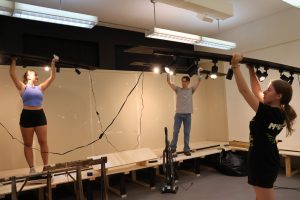
Left to right, students Kyra Klouzek, Rusty Thompson and AnnaLee Simpson are about to place a new lighting track in the exhibit room.
Fellow junior Rusty Thompson, who is pursuing the same degree, said working on this project has given him the sense of belonging he had while he was in the Air Force. He also enjoys creating things. He noted that exhibits are built from the ground up and that many people do not realize all of the work that occurs behind the scenes to develop one.
Another student who is working on this project and is seeking the same degree is senior AnnaLee Simpson. She has had an opportunity to work with a variety of collections at museums and enjoys cataloging and inventorying objects. She envisions serving as an archivist or registrar in a museum.
She enjoys the fact she will know she played a part in the development of this exhibit, and she likes the storytelling aspect. She has particularly relished the social element of working on this initiative.
“I like making connections and being able to work with people like Sydney, who I took classes with and works in the field that I am going to enter,” Simpson said. “It will help me get my foot in the door with some different institutions.”
Additional information about Tusculum’s history program is available at https://site.tusculum.edu/history/, and people can learn more about the museum studies program at https://site.tusculum.edu/museum-studies/. Further details about the university are available at www.tusculum.edu.
People can access more information about the museum at https://www.greenevillegreenecountyhistorymuseum.com/.