


GREENEVILLE – The Tusculum University Nature Trail, which has provided a peaceful space to relax or obtain some valuable exercise, will have an easier access point near the Doak House Museum with the construction of a new bridge.
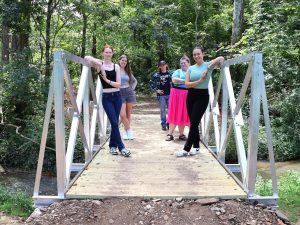
Tusculum University students show the new bridge. They are, left to right, Sage Clapp, AnnaLee Simpson, Rusty Thompson, Mirissa Walters and Kyra Klouzek.
Tusculum received a grant of about $30,000 from the state that enabled the university to replace the former bridge, which was destroyed in the aftermath of Hurricane Helene. That grant also provided funds for Tusculum to remove multiple trees that fell on that bridge. The Tennessee State Museum administered the grant funds.
“We’re grateful to the state for providing the grant to provide an optimal entry point near the Doak House with the new bridge and address trees that fell on the former one,” said Dr. Peter Noll, professor of public history and museum studies. “The trail’s accessibility is even greater, and people should come and use it even more than they already have been.”
Tusculum opened the trail in 2021 after spending a year clearing pathways and creating the routes. The university has performed trail maintenance and made needed revisions ever since, and the pathways have been one of the projects for Tusculum students to complete as part of the annual Nettie Fowler McCormick Service Day.
The trail starts at the Doak House grounds and runs through the woods to the Paul E. Hayden Educational Wetland. It features a couple of forks that can take hikers in other directions, and a portion of the trail runs along College Creek. A round trip on the trail totals about one mile.
When heavy rain and raging waters hit the region in the wake of Hurricane Helene a year ago, the original bridge near the Doak House was damaged when a huge oak tree fell and hit a series of other trees. The foundation of that bridge lifted about 12 inches and turned the structure at an angle.
That prevented entry to the trail from that end and necessitated the trail’s closure. But in about three weeks, the university was able to reopen it after students and faculty members built and installed a new temporary bridge near the academy building, cleared some of the damage and created some new pathways along the route for people to hike until the university could tackle the complete cleanup.
But some of the major damage caused by the falling of trees remained. The grant funds allowed the university to hire a professional tree service to come with a boom to safely remove fallen trees that impacted the original bridge.
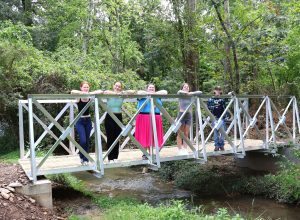
Tusculum University students stand on the new bridge. They are, left to right, Sage Clapp, Kyra Klouzek, Mirissa Walters, AnnaLee Simpson and Rusty Thompson.
Thanks to the state funds, the most dramatic change has been construction of a permanent bridge over College Creek between the original one and the temporary one that is much wider and durable. It is 24 feet long and 6 feet wide.
What is especially nice about the bridge is that requires no steps to reach it or walk across it. The university still has some additional work to complete to enhance the connection between the bridge and the walkway to the Doak House that will further benefit the trail.
“It will be extremely easy for people to walk or push a stroller over this bridge,” Dr. Noll said. “We are extraordinarily happy with the new bridge and know those who walk the trail will be pleased with it as well.”
Dr. Noll said students will perform more work on the trail during this year’s Nettie Day, which will be held Friday, Sept. 26. But he said the university has been able to restore most of the trail’s original pathways.
The trail includes a small picnic area near the new bridge where people can eat a meal or simply enjoy a quiet moment in nature. Dr. Noll hopes one of the 10-minute plays during the “Edgar Allan Poe and Other Haunted Stories in the Woods” performances Friday, Oct. 24, and Saturday, Oct. 25, will be held on that side of College Creek.
Dr. Scott Hummel, Tusculum’s president, said the trail is an excellent amenity for the university and the community.
“The trail is a wonderful place for our faculty, staff and students to enjoy some down time,” he said. “We are also thrilled that many people in the community are using the trail, which gives them another opportunity to experience the beauty of our campus. The trail has been a great civic engagement initiative by our faculty, staff and students and increased visibility of our historic Doak House Museum.”
The trail is open during daylight hours every day of the year. Anyone who has questions about the trail or who would like to help with its maintenance can email Dr. Noll at pnoll@tusculum.edu.
More information about the university is available at www.tuculum.edu.