


GREENEVILLE – Seventeen Tusculum University family members have a more complete understanding of mental health issues affecting students following recent training from experts in the field.
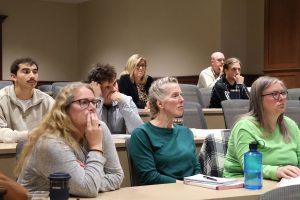
Faculty, staff and students participate in the training.
Group members also learned how they can provide first aid on these matters until a student can receive more in-depth care. As a result of participating in the training, those faculty, staff and students became certified in adult mental health first aid.
“We commend these Tusculum family members for their initiative and concern for students,” said Dr. Scott Hummel, the university’s president. “Tusculum is focused on a proactive and holistic approach as part of our caring Christian environment to support our Pioneers who might be experiencing difficulty in this aspect of their lives. Students will further know through this training that their well-being is uppermost in our minds.”
Conducting the training were Lacodya Williams, a social counselor with the Greene County Health Department, and Steve Hartley, a paramedic with the Washington County/Johnson City Emergency Medical Service.
The training was part of Tusculum’s First-Generation College Celebration Day observance this year. The university’s First-Gen Network Committee, which contains faculty and staff members who are invested in supporting first-generation students, organized the event. First-generation students do not have a parent or guardian with a bachelor’s degree.
One of the committee’s task forces concentrates on faculty and staff education in assisting first-generation students.
“A conversation within the task force revealed a need for mental health training for our faculty and staff,” said Meagan Stark, director of Student Support Services, a federal grant program at Tusculum for first-generation college students. “This isn’t particularly surprising as mental health issues are rising among college students nationwide, but given our campus size and our one-on-one connections with students, our faculty and staff felt they would benefit from training to appropriately address mental health concerns inside and outside the classroom.”
While the training will be helpful for working with first-generation students, the information participants obtained will be applicable to supporting all other students, faculty and staff as well. Stark said she hopes those who are now certified will feel confident when they recognize concerning signs in others’ mental health.
“Given the nature of my work, I’m fairly well-versed in trauma-informed educational practices, but even I felt like I was learning from the material,” she said. “Chiefly, it encouraged me to stop and pay attention to those around me. We are always so busy that when a student or colleague tells us they are having a bad day, we tend to make a joke or commiserate rather than offer them a chance to talk about their emotions. This course reminded me to pay attention to the folks around me and offer them multiple, nonjudgmental avenues to talk about their emotions, particularly when they are difficult emotions.”
Holly Ratcliff, assistant professor of English, was another participant in the training. She said she wants to be a resource for students facing mental health issues in addition to teaching them about English. She believes all students at Tusculum and other higher education institutions need some type of mental health resource at their disposal. When she saw this training, she viewed it as one of the ways Tusculum might be addressing the matter. Because she is in regular contact with students, she felt she could be part of the solution.
“I have individual conferences with students, where we discuss items such as how they are progressing on a paper,” Ratcliff said. “Inevitably, I learn they are having trouble with various life issues, like finding a doctor and getting back and forth to their hometowns, so I felt I could probably learn a little more about this.”
One of the takeaways for Ratcliff was for her to suggest to a student who is struggling with a class assignment to not try to complete it in the same way as others. For example, if a 30-minute assignment is problematic for a student, perhaps he or she could tackle it in three, 10-minute increments. Another lesson she learned is to be direct with students who are obviously struggling and ask in a friendly and helpful manner what is troubling them. She found that to be helpful advice and an avenue for her to discover what is happening with them.
Ratcliff teaches a lot of freshmen and notices something is amiss.
“I know how much they are struggling in their first semester,” she said. “It’s a huge adjustment, and that has to affect their mental health. I figured if I was more knowledgeable about this topic, it would give me some kind of foundation to think about ways I could actually suggest that they do some things differently. I feel like this has given me some more tools to feel like I have a better, more well-rounded approach to the many things students might need while they are here.”
The 17 Tusculum family members who are now certified are:
- Sandi Bible, academic advisor with Educational Talent Search
- Audrey Brackens, executive assistant in the Office of Academic Affairs
- Laura Carr, administrative assistant for SSS
- Adam Denton, assistant professor of psychology
- Robert Gall, assistant dean of the Social Sciences Division
- Heather Henson-Ramsey, assistant vice president of academic affairs
- Caden Jones, campus safety officer
- Betsy Long, academic support coordinator
- Carter McIntyre, student
- Sydney Poythress, student
- Holly Ratcliff, assistant professor of English
- Jayden Rios, student
- Meagan Stark, SSS director
- Kelsey Trom, professor of English
- Chelsey Wade, academic advisor with Talent Search
- Chelsea White, assistant registrar
- Janelle Zirger, student
More information about the university is available at www.tusculum.edu.