


GREENEVILLE – Raised in a Christian family in Georgia, Bill Edmonds learned the principles by which everyone in the household lived, including love and the Golden Rule.

Bill Edmonds speaks during the African American Read-In.
“I remember going to church before I started school,” Edmonds said during his remarks Tuesday, Feb. 24, at the African American Read-In at Tusculum University. “And those values are still with me today. You learn respect for people, and you treat them as you expect them to treat you. And this is what I have believed or tried to live throughout my life. There is a verse from a song that says, ‘Let the life I live speak for me.’”
Edmonds kicked off the annual event at Tusculum, during which students, faculty and staff honored African-American writers by reading their works. He is a 1971 graduate of Tusculum, who earned a bachelor’s degree in sociology and subsequently worked for the state of Tennessee in a variety of professional positions for 41 years. He retired from Walters State Community College in 2011 as associate director of disability services.
He served on Tusculum’s Board of Trustees for eight years.
A beloved person in the community, many individuals came to hear his talk, called “Evolution of a Tusculum graduate.”
One of the people he came to know was Eva White, the first African American student admitted to Tusculum. Dr. Peter Noll, professor of public history and museum studies, shared a bit about her history at Tusculum as part of the occasion. After graduating from Tusculum, she earned a master’s degree and taught in Greeneville.
The region in which Edmonds lived as a youngster in the 1950s and 1960s did not adhere to the guidelines by which he was shaped. He said not all of his experiences were pleasant for him or other African Americans. Edmonds shared that his parents taught their 11 children to understand their surroundings – to be careful, know where they are and be aware of the people they are near and know what is going around them.
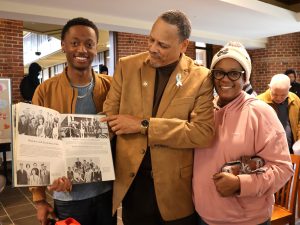
Bill Edmonds, middle, shows his photo in a Tusculum yearbook. He is joined by his daughter, Elise, and grandson, Tai.
“There were places you went and places you didn’t go,” Edmonds said. “You didn’t go looking for trouble because it would truly find you. Sometimes, trouble would come looking for you. You could be at the wrong place at the wrong time – never seen or heard from again. I never experienced physical violence, but I got looks. I got verbal abuse.”
While he knew some white people, Edmonds was unable to establish any type of friendly relationships with them because of the Jim Crow laws in place at that time. He remembered a classmate of his who was executed at age 16 after being accused of raping a white woman.
“These were some of the things we had to live with in the Southeast,” Edmonds said. “You don’t get over that thing. You visualize that forever.”
Sixty years ago, Bill Edmonds’ high school guidance counselor attended a college fair in Atlanta, and a representative of Tusculum was present. One thing led to another, and after receiving a scholarship, Edmonds enrolled at Tusculum. He was joined by three other African Americans from his high school as well as a student from Liberia and another from Jamaica. He said he felt somewhat intimidated by the presence of so many whites.
“I was not necessarily afraid, but I was very cautious,” Edmonds said. “I was extremely aware of my surroundings, what I did and where I went. Tusculum was not at all what I expected. I did not know what to expect, but I was pleasantly surprised at what I found here. Tusculum served as a laboratory for me and for a lot of other students in terms of changing attitudes and changing what I felt. I did feel some hatred, and that was not good. But Tusculum helped erase a lot of preconceived notions I had about 99% of the white population.”
Edmonds credits classmates from the Turner House on campus who recognized his anguish and took him under their wings.
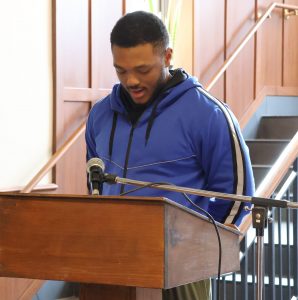
Tusculum student Adam Billingsley reads “Caged Bird” by Maya Angelou.
“We started making friends,” he said. “They were the first friends I had in terms of people I could trust. I felt the sense that this person had my best interest at heart or would not hurt me. The people that surrounded me – faculty, staff and students – treated me as if I was any other student. My fellow dorm members wanted to include me in everything that they did.”
One of today’s students, JP Campione, wrote a feature story about Edmonds and introduced him at the event.
“When you introduce someone, it’s easy to begin with a list of accomplishments – degrees earned, years served and titles held, but those things only tell part of a story,” Campione said. “And story is what this event is all about – stories that carry memories; struggles; resilience; and, most importantly, love. Throughout his life, Mr. Edmonds has encountered and demonstrated all of these. Through it all, he has led with love, treating people with dignity, offering guidance as needed and choosing to open doors for others, not because it was demanded but because it was right.”
Steve Anderson, a Tusculum alumnus and the outreach and retention specialist with Student Support Services, met Edmonds when he was a student.
“He teaches you the ropes, he tells you the people to be around, and that made me more comfortable,” Anderson said. “If it wasn’t for him, I wouldn’t have graduated in 2004 because he helped keep me here.”
At the conclusion of Edmonds’ talk, Tusculum took time to celebrate the words written by African American authors in a variety of genres. One by one, students, faculty and staff went to the microphone to read all or part of various reading material.
Among the works that were highlighted were:
- “Topdog/Underdog” by Suzan-Lori Parks
- “Letter from the Birmingham Jail” by Dr. Martin Luther King Jr.
- “Harlem” “Freedom” and “Dreams” by Langston Hughes
- “In and Out of Time” and “Caged Bird” by Maya Angelou
- “Change Is Going to Come” by Sam Cook
- “Baptism by Dirt” by Frank Walker
- Acceptance speech by Thurgood Marshall after receiving the Liberty Award
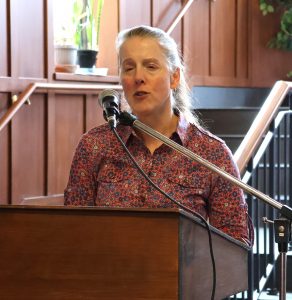
Kelsey Trom speaks at the event.
Kelsey Trom, professor of English, who organized the event, said it was important to recognize the works of African Americans. She noted that writers of color make up just 12-20% of the books published by major publishing houses. By comparison, people of color represent 40% of the population.
Trom serves as the editor of “The Tusculum Review,” the university’s international literary journal. She said she was proud of the 21st edition, which was published in the fall. She said it was reflective of the population as a whole.
Additional information about Tusculum’s English program is available at https://site.tusculum.edu/english-2/. To learn more about the university, please visit www.tusculum.edu.