


GREENEVILLE – Tusculum University professors and students as well as business leaders provided context about practical usage of artificial intelligence and shared examples of its applicability during a summit at Tusculum University.
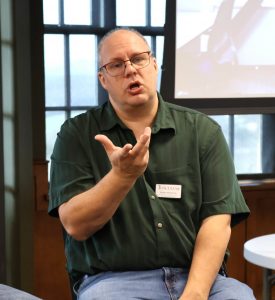
Walter Wimberly speaks at the summit.
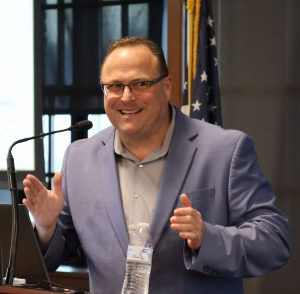
David Hite welcomes the audience and speaks about artificial intelligence.
The Appalachian AI Summit Wednesday, March 11, attracted about 80 people to hear experts share their knowledge about this rapidly evolving form of communication and conducting business. Among those who attended were educators, small and large business owners, representatives of nonprofits and those involved in workforce development.
“We were delighted to host this summit and help people better understand the value of AI in enhancing outcomes while using this tool in an ethical manner,” said David Hite, director of Tusculum’s Center for Free Enterprise and New Venture Creation, who organized the summit. “AI is a tool that’s going to build a connection to opportunity. The biggest risk is doing nothing. Thirty to forty percent of productivity gains can be obtained if we utilize AI effectively.”
Messages from the speakers
Hite, who also an associate professor of business, emphasized the importance of addressing the AI skills gap.
“We need to build AI literacy across all organizations,” he said. “We need to think about how we integrate AI into our daily work. About 70% of managers say AI is critical for success, but the funny thing is only 14% of our workforce is prepared. We really need to think about that and take steps toward changing that reality.”
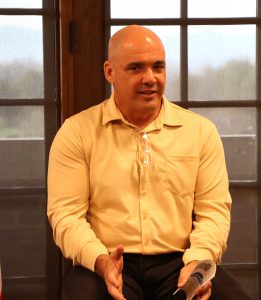
Joe McKenna makes a point about AI.
Tusculum is addressing that knowledge need by offering a minor in applied AI for businesses and embedding AI into the university’s curriculum. Hite collaborated with Joe McKenna, an adjunct professor at Tusculum, to offer free AI training to students, professors and staff. McKenna manages CrushingIt.ai, a nonprofit organization focused on long-term economic resilience in the Tri-Cities area of Tennessee, and Cloudwise Academy, which helps people and businesses in Northeast Tennessee develop practical digital skills that lead to real work, outcomes and economic opportunity.
The summit included a breakout session for educators that discussed how AI is transforming teaching, learning, assessment and student experiences. It also included strategies for rethinking academic integrity and assessment with AI now a factor. In addition, the session explored how institutions can better prepare students and organization for AI-incorporated workplaces while creating ethical guidelines and institutional guardrails.
Another breakout session focused on the ways East Tennessee organizations are starting to apply AI in real business situations. That includes automating routine work, improving decision-making, enhancing marketing and increasing operational efficiency.
The event featured a panel discussion with several pioneers in AI and education and a live demonstration of what is called “vibe coding” in which an AI-powered tool is designed and built in about 45 minutes. It showed how humans and AI work together to quickly turn ideas into working solutions.
Raul Gomez, chief revenue officer at IntiCo, which is a leader in customer experience technology solutions for a variety of industries, delivered the keynote address. He is an educational partner with Tusculum and is involving students on projects.
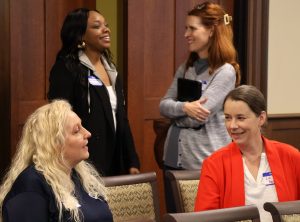
Attendees converse during a break in the summit.
He reinforced Hite’s message about the need for people to develop skills in AI because of the changing workforce. Employees who do not know how to use AI as a tool will probably be the first that is not able to be productive in their organizations if that is required, he said. Gomez said AI is an essential part of business success because it strengthens customer service by providing quicker responses that will increase the chances of the consumer picking that company.
Gomez said business principles of recognizing the primary problem the person using AI is trying to solve and the workflow that will be used to achieve it as well as knowing the use case are still important. He also said it is wise to determine whether AI is really necessary in a particular situation.
“It’s important to understand where you’re starting and where you want to go with AI,” Gomez said. “If you don’t, when you try to inject AI and it’s not clearly defined, that’s where your pilot stalls. That’s where these point of approval concepts fall apart.”
While they touted AI and its positive impact on the future of education and the economy, speakers at the summit said AI is not magic and that there is still a need for human input on projects that use that technology. From an academic standpoint, Walter Wimberly, assistant professor of computer science at Tusculum, emphasized that AI should not replace thinking or supplant core competencies.
Thoughts from attendees
Sara McMurray, who handles communications, marketing and hospitality for Niswonger Performing Arts Center, came to the summit in a personal and professional capacity. She said she is learning how to use AI for her present position and others that might come along and already knows the tools and some of the applications. She is interested in career paths that dovetail with AI. She found the summit to be beneficial.
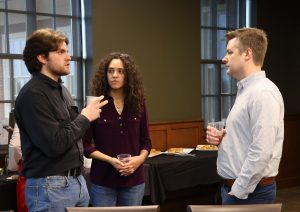
Kol Dorney, left, who runs KoldOps, networks with others at the summit.
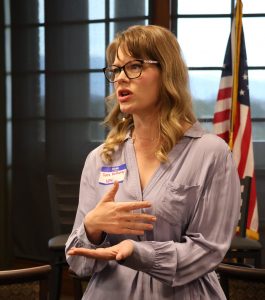
Sara McMurray speaks with a fellow attendee during a break.
“Learning how people are using it in really practical applications is super helpful for knowing how to address pain points,” she said. “Hearing that automation produces the fastest ROI was really good. I’m always looking for new tools. I love to hear what other people are using in the moment and then research it and see if there’s any application for my current position.”
Kol Dorney, who runs KoldOps, which is based in Knoxville and automates manual processes for manufacturing, construction, oil and gas companies said his business has been looking into AI agents and their capabilities compared to other options. He came to the summit with a skeptical eye about AI and wanted to see whether that tool is practical. He was curious how AI is being applied in a more local environment.
“I think there were some great panelists who were bringing it back to practical use cases from where AI deploys,” Dorney said. “That was one of my favorite parts – being able to pick their brains afterward. We’re very glad we came and got a great topography of how AI is affecting more local markets. In these local areas, it’s super valuable to see how people are looking at technology and how they are investing in it. It’s going to help us in our decision on derisking versus investing more heavily. We’re already invested, but it’s figuring out how many eggs are going into that basket.”
Another attendee was Aristia Kinis, who worked in schools on the administrative side and serves at a research nonprofit called Open Research. She sought to learn more about the way AI is showing up in the community and attended the breakout session for educators.

Kelly Griffith listens during the breakout session for educators.
“I thought the session was particularly useful even now that I’m outside K-12 education and academia,” she said. “The demonstration about Notebook LM, even for me as an individual learner, was just so practical. I had not tried it before, so it was cool to see that as a demo. I’m going to try everything they told us and use it with concepts that I’m still unclear on.”
Kelly Griffith, an assistant professor of computer science at Milligan University, learned about the summit through the Appalachian College Association and decided to take advantage of her spring break to expand her knowledge. She is going to teach an Introduction to AI course in spring 2027, but she is also going to pivot in one of her current classes to have her students bytecode to create an app.
“Part of this summit is exploring other things for course preparation,” she said. “I just wanted to come and see more because we can never know enough about this subject as we go into it.”
Anyone with further questions about the summit can email Hite at dhite@tusculum.edu. More information about Tusculum is available at www.tusculum.edu.