


GREENEVILLE – One of the hallmarks of a Tusculum University undergraduate education is the ability for students to perform research and display and explain their work to others.
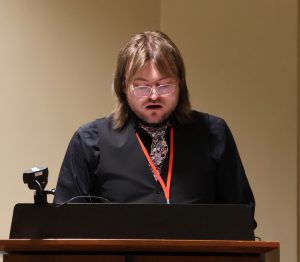
Chris Colmer discusses his history research.
Tusculum celebrates the development of that skill and provides the forum for students to share it during the annual Academic Symposium on campus. The university recently held that event, enabling students in multiple academic disciplines to showcase their knowledge to other members of the Tusculum family.
“The symposium is an outstanding event and one of the highlights of the year for all of us,” said Dr. Scott Hummel, Tusculum’s president. “Studying at Tusculum means engaging in active and experiential learning, where students apply what they learned in the classroom to real-world situations. This type of education prepares them to be career-ready professionals and to be highly successful in advanced degree programs. The symposium is a key part of their development.”
During the symposium, history students orally presented their research projects, and English students read some of the writing they created. Science and social science majors presented their research on posters and explained their methods and conclusions to other Tusculum family members who visited their stations.
For some students, this is not the only time they will present their research in a public manner. They also accept opportunities to appear at regional, national or international conferences. Others have received stipends to conduct research during the summer through the Appalachian College Association and give a summary of their work that is posted to the organization’s website.
Putting together research projects
Six students who have studied under Dr. Adam Denton, assistant professor of psychology, participated in the symposium. Some were in the earlier stages of their studies at Tusculum and others were about to graduate. He said every student who is a psychology major has to take the Research Methods in Psychology class. That class is taught by him and Dr. Kate Smith, professor of psychology, and students learn how to build a poster.
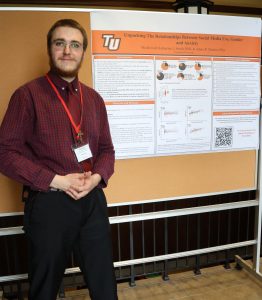
Micah Gall stands by his poster.
The process of completing the research project begins with obtaining Institutional Review Board approval followed by a major survey that delves into the topic with others. Additionally, students review professional literature and journals and other reputable sources to increase their knowledge on the subject and combine it with data from the survey to create the poster. Dr. Denton assists the students with the advanced mathematical and statistical modeling of the data.
Finishing everything takes about a full academic year, Dr. Denton said. In addition to presenting at the symposium and other potential locales, students could be fortunate to have their work published in some type of professional outlet.
Dr. Denton said students benefit considerably from participating in research. He and his colleagues teach the students how to read an academic journal and how to assess whether it is a good or bad one. Students learn how to craft a presentation that maintains the interest of a person that is hearing about the subject. They also discover the art of scientific writing.
“First and foremost, they develop their scientific thinking,” Dr. Denton said. “Some scientific thinking is a skill anyone can learn, but it’s something that you have to practice and cultivate. The best way to become good at thinking like a scientist is to get your hands dirty by participating in it.”
There is also a bottom line about the importance of research.
“In my field, you cannot get into graduate school unless you have research experience,” Dr. Denton said. “Unless students have something where they can say, ‘I know how to do this,’ their application probably won’t even get looked at.”
Dani Beckham
One of the symposium’s participants was Dani Beckham, a senior psychology major, who explored the impact of injuries on an athlete’s mental health. The conclusion was as that depression, anxiety and stress increase, an athlete’s qualify of life diminishes. She said she enjoyed conducting research.
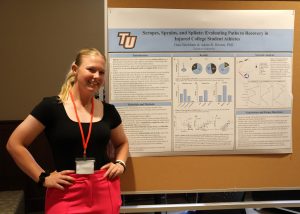
Dani Beckham stands by her poster at the symposium.
“Dr. Denton was very helpful,” said Beckham, who plans to pursue a career in clinical psychology working with children in underserved populations. “I’ve learned to love the analysis component – seeing the graph and seeing how things correlate and if there is causation. I’ve also enjoyed the part of interacting with different people and learning under them and through them.”
Beckham plans to go to graduate school and feels well prepared for that next stage in her academic career based on her Tusculum experience. She took the Research Methods class and then expanded her skills with Dr. Denton. She learned to perform the work herself while still having a professor who could give her advice on ways she could tackle the project.
She spoke with many athletes during her research and enjoyed that interaction, but she said it was also appealing to build relationships with her professors who helped guide her through the process. Besides Dr. Smith and Dr. Denton, she said Dr. Robert Gall, assistant dean of the Social Sciences Division and professor of psychology, helped her tremendously.
Janelle Zirger
Janelle Zirger is a senior who is majoring in criminal justice with a minor in psychology. She presented at the symposium for the third time this year and has been invited to events at other institutions, including the University of Pennsylvania. As a first-generation student, meaning her parents do not have a bachelor’s degree, she was eligible for Student Support Services, a federal grant program that opened doors for her to be named to the Ronald E. McNair Postbaccalaureate Achievement Program. That program enabled her to conduct research during the summer.
Zirger credits the Tusculum professors with whom she spoke and who saw her potential in research classes and her interest in that type of coursework. She also highlights her own initiative in helping her attain this success. Working with Dr. Denton, her mentor, was also beneficial because he not only provided her guidance on her research on law enforcement but also on what she could expect in graduate school.
“The model from the beginning with SSS is to accomplish my desired goal on my own accord, but they gave me the tools and resources to help me,” Zirger said. “I’ve worked with Meagan Stark in SSS a lot in the last four years to prepare for graduate school.”
She feels 100% prepared for graduate school and will enroll in the fall at East Tennessee State University for a master’s degree in criminal justice and criminology. She will attend tuition-free and fee-free.
Max Mull
Another participant in the symposium was Max Mull, who obtained a bachelor’s degree in history from Tusculum in December and is now working on a Master of Sport Management from the university. His subject matter for the symposium was the importance of the print revolution in connection with the Protestant Reformation. He argued that the reformation would not have reached such a large scale without that printing revolution.
Mull addressed this topic as part of his senior thesis, which required a minimum of 25 pages. His research was challenging because it did not have as many primary sources as he would have liked from which he could obtain information. But he said Dr. Joel Van Amberg, professor of history, assisted him by providing a book about the history of the Bible starting in 1450 continuing into the Modern Age. Dr. Van Amberg also pointed him to some other sources.
“For the most part, I like research because it’s fun to discover new things and learn how operated, thought, acted and spoke centuries before us and just watching that evolve,” Mulli said. “In my presentation, I talked about the pamphlets and some of the pictures that were created for people that weren’t necessarily literate at the time. It was fun to see some of those pictures and pieces of art that people would come up with to convey a message.”
Sophia Derrick
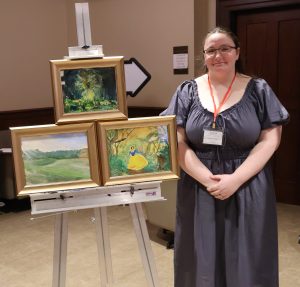
Sophia Derrick shows her artwork.
Sophia Derrick, a sophomore art and design major, showed three pieces of art, including an abstract painting and one of her backyard with Snow White in it. This was the first time she had put her work on display in a public manner.
“It was pretty exciting,” she said. “It was a little nerve-wracking, but it was a good opportunity. It’s just nice for everyone to have their work up together and see everyone’s takes on their subject. “
Based on her experience at the symposium, she is ready to make exhibition of her art a regular part of her routine.
More information about the university is available at www.tusculum.edu.