


BRISTOL, Tenn. – As football season prepares to kick off, a Tusculum University assistant dean, who is also an athletic trainer, is helping local paramedics, emergency medical technicians and firefighters have the most up-to-date information for treating injured players.
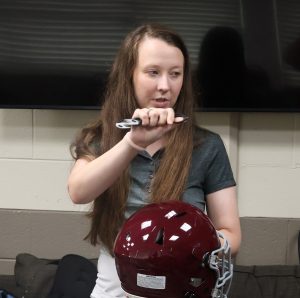
Dr. Emily Davis discusses the removal of a helmet with first responders at the Bristol Fire Department.
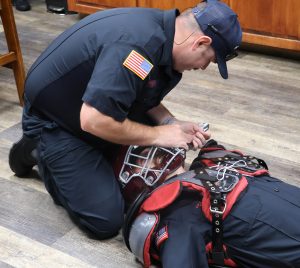
A member of the Bristol Fire Department practices the removal of a helmet.
Dr. Emily Davis, assistant dean of sport studies, recently conducted three days of training with the Bristol, Tennessee, Fire Department. She focused on current protocols for removal of helmets and shoulder pads when players have a potential injury to their neck.
“We work with EMS personnel constantly, and they are professionals with experience in handling spine boarding and cervical spine injuries, but they are not necessarily going to see football equipment every day,” she said. “The purpose of this training is for them to gain hands-on experience with the way helmets and shoulder pads would be removed should they have to deal to deal with an-field injury, particularly with football.”
Dr. Davis has served as an athletic trainer at local high school and middle school games. She has worked at Tusculum games when the university’s athletic training staff needs extra coverage. She was previously an athletic trainer with Knoxville Orthopaedic Clinic, formerly known as OrthoTennessee, and a certified athletic trainer at Volunteer High School.
She is licensed as an athletic trainer in Tennessee and is certified in that profession by the Board of Certification. She has served as president of the Mountain Athletic Trainers’ Society since 2018.
One of the messages Dr. Davis wanted to convey to Fire Department personnel is that the athletic trainer will be ready to assist first responders when they respond on the field to an injured player.
“We’re really emphasizing learning all about what the different types of helmets will be, the different clips on the helmets and the way to remove a face mask,” she said. “We’re also looking at the shoulder pads – exactly how those are going to be put on and removed so we can get them off as safely as possible for the athlete.”
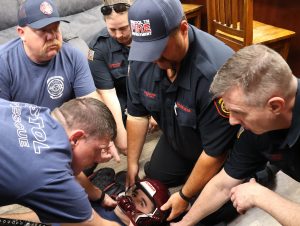
Members of the Bristol Fire Department remove a helmet from one of their colleagues during a practice session.
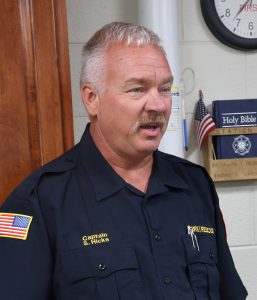
Steven Hicks, a captain with the Bristol Fire Department, talks with his crew.
Steven Hicks, a captain for the Fire Department, said the first responders felt it was wise to have the additional training with the start of the fall athletic season in local schools just around the corner. It is part of the continuing education these medical personnel regularly receive. Dr. Davis was ready with a lesson, and the Bristol Fire Department requested the assistance.
“We called her in just to give these ladies and gentlemen a little bit more knowledge in case we have to take care of someone who has a neck or spinal injury or there are complications with taking off a helmet or shoulder pads,” Hicks said. “This is kind of a refresher and new information about helmets and shoulder pads that we can have at our fingertips so we can be ready for anything.”
Hicks said there are a variety of potential injuries a player might have sustained that warrant the training the Fire Department received. This training is reinforcing some procedures, but it is also providing some new tips that can prove to enhance medical care. He said Dr. Davis was helpful in sharing information about the new styles of helmets that will prove beneficial should care be needed.
“The exercise is very interactive,” he said. “The firefighters have to put on the helmet and the pads and act as a victim so the others can participate in the hands-on training of properly removing the helmet and holding the cervical spine. We appreciate Emily and Tusculum University for letting her come to the station and conduct this training. She has provided us with some really good knowledge.”
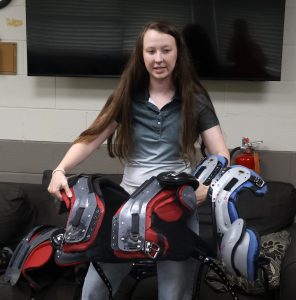
Dr. Emily Davis talks about shoulder pads with first responders.
Dr. Davis believes the first responders enjoyed the session, in large measure because they were able to actively participate rather than sit and listen to a PowerPoint presentation. Steven Carroll, a paramedic, liked his lesson.
“Football equipment is evolving like everything else,” he said. “The ways we used to do it five years ago, two years ago might not be the way we need to be doing things now. If there is an easier and safer way to take off the advanced equipment to keep the players safe and to make it easier on the responders, that is helpful.”
This community service is the latest by Dr. Davis. Earlier this year, she visited Tri-Cities Christian Academy and Science Hill High School to speak with students about the profession. These community activities align with Tusculum’s commitment to civic engagement, a key principle in the university’s mission.
Tusculum offers a bachelor’s degree in sport science pre-athletic training, and people can learn more about it by visiting https://site.tusculum.edu/pre-athletic-training/. More information about the university is available at www.tusculum.edu.