


GREENEVILLE – Art and science recently intersected at Tusculum University as two academic programs partnered to create a hands-on learning experience for students involving leaves and vegetation.
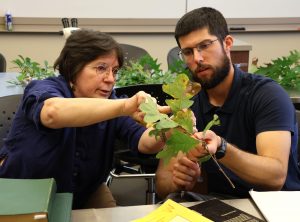
Dr. Susan Monteleone, left, and Benjamin Conley examine details of a leaf.
Dr. Susan Monteleone, professor of biology received assistance from Benjamin Conley, assistant professor of art and design, in two plant biology lab classes. Day 1 consisted of Conley teaching the students fundamental techniques of drawing and then heading outdoors on campus to sketch vegetation under an oak tree. The second visit consisted of students creating detailed drawings of leaves they had examined under a microscope in one of the environmental science laboratories.
Dr. Monteleone was grateful for Conley’s willingness to share his expertise with art to strengthen the students’ knowledge.
“This collaborative effort with scientific illustration enriches students’ appreciation of visual intricacies while enhancing their observation skills that come with studying the living world of plants,” she said. “Technical representations of plant characteristics are useful when someone studies similarities and differences of specimens under examination. Skilled observation of identifying characteristics found in live specimens takes practice and familiarity with the myriad variations of these characteristics found in nature.”
This was a timely project for Conley, whose current practice and research explore human relationships and their connection to nature. When Dr. Monteleone asked him whether he would be interested in helping teach her lab, he was thankful for the offer and quickly agreed.
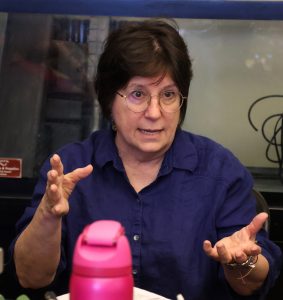
Dr. Susan Monteleone makes a point during her lab.
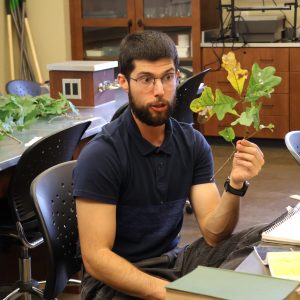
Benjamin Conley holds an oak branch as he instructs students on observation for their illustration.
“Blending biology and art is already deeply embedded into my studio work,” he said. “Much of my body of work deals with the natural world in very descript and textural formats. Simultaneously, I just love to draw and teach others to draw. It is one of my favorite courses to teach. Having the opportunity to teach students observational drawing directly from natural and organic sources is right up my alley.”
Before Conley joined the class, Dr. Monteleone had provided the students with all of the technical and scientific knowledge they needed about plants. The class had also looked at plants through the microscope under her guidance, but when Conley entered the class, the learning process for students incorporated another dimension.
Dr. Monteleone had engaged in this type of partnership with art professors before and discovered it was extremely beneficial to students and faculty members. She touted Conley’s skill in guiding students to drill down on visual details so they could methodically and artistically present what they saw.
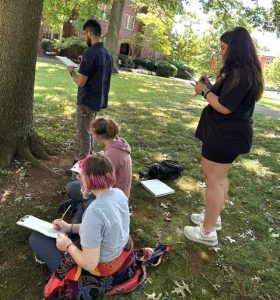
Benjamin Conley, top left, and students sketch vegetation under an oak tree.
She was impressed with the outcome, saying the students were impressive in their ability to visually document a plant’s descriptive characteristics.
“By combining empirical observation with visual expression, this interdisciplinary approach enhances student learning across both fields and bridges the gap between rigorous data and human comprehension,” Dr. Monteleone said. “In other words, it teaches students to translate complex scientific phenomena into clear, accessible visual narratives.”
During his first session with the students, Conley taught them about contour lines, gesture drawing, composition and value, which he said are core elements of drawing observationally. He said it is “mind-blowing” for students when they learn to draw based on what they see versus what they know.
“It forces individuals to truly observe the intricacies of their subject, not what they think their subject looks like,” he said.
Students enjoyed the experience. Junior Charis Rietveld, an environmental science major, said she likes science and the creative arts. She said the project made sense.
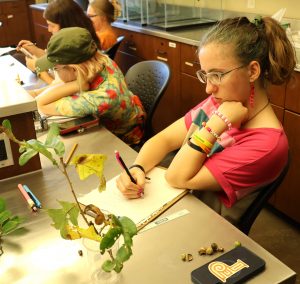
Student Charis Rietveld, foreground, works on her drawing.
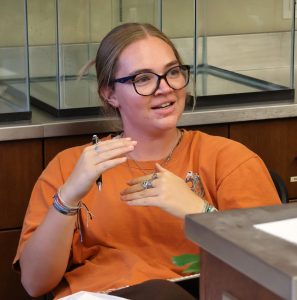
Student Jordyn Kwalwasser participates in class discussion about the project.
“As someone who might become an environmental scientist, I might need to create illustrations,” she said. “It was relevant and really fun. We were already learning about leaf veins and all of the little details, but it was different when you had to really look at it and replicate it when you draw it. It was really helpful to look at all of the relevant little details in identifying plants because you have to see those details in order to draw them.”
Senior Jordyn Kwalwasser, who is also pursuing a bachelor’s in environmental science, said the drawings provided a different perspective for the students.
“We’re reading about it in the textbook, learning about it and looking at pictures of it,” she said. “But when you have to actively interpret specific parts of plants that you wouldn’t necessarily focus on in that way and you have to draw them in a specific way, you have a lot more attention to detail. When you’re looking at it and you’re drawing it, you’re comprehending, ‘Oh, this is actually what it looks like.’ And you kind of digest that information a lot easier. I think it’s helped all of us in that class to learn in that manner.”
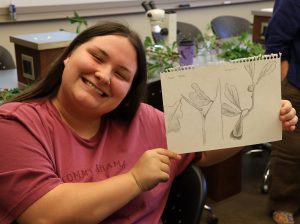
Student Amanda Owens holds her drawing.
Kwalwasser also appreciated the opportunity to learn about art concepts.
As he reflected on the exercise, Conley said it highlighted the approach to learning that is available to students at Tusculum and ways the university’s faculty can have varied teaching experiences.
“This is an incredible example of interdisciplinary opportunities at TU,” he said. “Because we are small university, faculty members are able to converse and create outside of their department. And, due to smaller class sizes, students can receive direct feedback from both Dr. Monteleone and me, at the same time.”
Additional information about the art and design and environmental science programs is available at https://site.tusculum.edu/art-and-design/ and https://site.tusculum.edu/environmental-science/, respectively. To learn more about the university, please visit www.tusculum.edu.