Update for Thursday, February 5


After further evaluation of the weather conditions,  all classes for the rest of the day will be converted to online instruction.

Employees who have already arrived at the office can stay to complete their day’s work. Those who were experiencing difficulty coming to the office can work remotely for the day.

The cafeteria and Zeke’s will continue to operate according to the regular schedule.
 

Plan for February 3, 2026


Tusculum University will convert in-person classes to online instruction, and employees will work remotely again Tuesday, February 3.

Students should check Canvas for instructions from their professors.

The cafeteria will have brunch from 10:30 a.m.-2 p.m. and dinner from 5-7 p.m. Zeke’s will open at 10 a.m.

Plan for Monday, February 2


For Monday, Feb. 2, Tusculum University will convert all in-person classes to online instruction. In addition, all employees will work remotely.

Students should check Canvas for instructions from their professors.

The cafeteria will have brunch from 10:30 a.m.-2 p.m. and dinner from 5-7 p.m. Zeke’s will open at 10 a.m.

Chapel and Fellowship of Christian Athletes will not be held.

Class format and work plan for Tuesday, Jan. 27


Based on conditions on and off campus,  all in-person classes will be conducted online Tuesday, Jan. 27. In addition, employees will work remotely for the day.

Students should be sure to check Canvas for instructions from their professors.

The schedule for the cafeteria and Zeke’s will be the same Tuesday. The cafeteria will have brunch from 10:30 a.m.-2 p.m. and dinner from 5-7 p.m. Zeke’s will open at 10 a.m.

 We encourage you to stay safe and take care of yourself and your family. The Office of Campus Safety remains a resource for students, if necessary.

Schedule change updates for January 26


After further assessment of conditions this morning, Tusculum University is further revising the plan for Monday, Jan. 26.

All in-person classes for the day will be converted to online instruction. Employees will work remotely for the day.

 The cafeteria will have brunch from 10:30 a.m.-2 p.m. and dinner from 5-7 p.m. Zeke’s will open at 10 a.m.

The university will send a message later today about the plan for Tuesday, Jan. 27.

Please continue to stay safe and take appropriate measures to protect yourself and your family. Students, remember that the Office of Campus Safety is available to assist you, if necessary.

Alumnus earns honor for best graduate student paper


A Tusculum alumnus who earned bachelor’s degrees in history and English from Tusculum in 2015 is now distinguishing himself in graduate school.

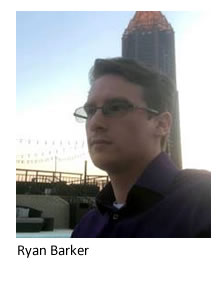
Ryan Barker, who is seeking a doctorate in history from Purdue University, was recently named the inaugural winner of the Southern Association for the History of Medicine and Science’s Robert Nesbit Award for Best Graduate Student Paper. According to the Purdue History Department, Barker delivered his prize-winning paper, “Terra Australis Jam Cognita: Matthew Flinders and Exploration’s Constructed Environment,” at SAHMS’s annual conference.

Barker also wrote a review for this month’s Journal for the Southern Association of the History of Medicine and Science about the book “Merchants of Medicines: The Commerce and Coercion of Health in Britain’s Long Eighteenth Century” by Zachary Dorner. You can read the review here.

During his time at Tusculum, Barker was a recipient of the Bruce G. Batts Award: History Honor Key: and an English, creative writing concentration, Honor Key. He was also a member of honors societies and the Student Government Association. In addition, he wrote and edited news release pertaining to the Tusculum Review, the university’s in-house international literary journal. He interned at the Office of Institutional Advancement and Museums of Tusculum.

We congratulate Barker on his achievements and wish him well as he completes his work on his doctorate!

Tusculum’s Facilities Management Department lives up to the mission of the University


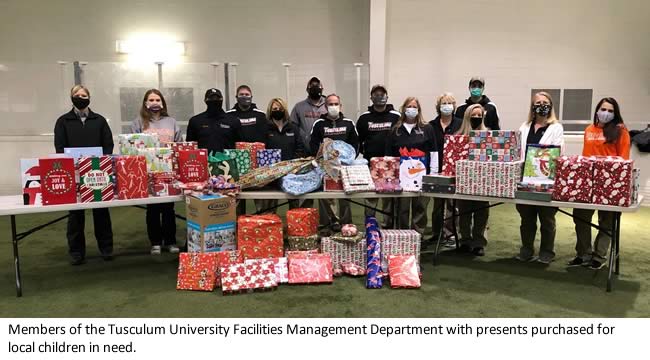
The Facilities Management Department’s 10th annual Christmas for Kids Auction was a major success, raising $1,719, with all proceeds used to purchase presents for local children in need.

Through the event, facilities helped eight foster children! In addition, the department was able to assist a Tusculum family member, whose child lost a lot of toys in a fire!

“The Facilities Department would like to express our gratitude for the donations that were contributed,” said Chad Grindstaff, facilities management director. “We want you to know how much we appreciate your help and know the children do as well. We would also like to thank the Athletic Department for not only donating several items but also once again providing us lunch during the auction.”

Schedule for December 2; no changes to final exam schedule


Because of the potential for ice on roadways in the early morning, Tusculum University will operate on a two-hour delay for Wednesday, Dec. 2.

Once again, there will be no disruption or alteration to the final exam schedule. Final exams for Wednesday, Dec. 2, will proceed according to the original schedule and will not be affected by the two-hour delay.


We will use the same procedures for remote working and early arrivals on campus that were in effect for December 1.

Employees who can complete their duties from home and have received approval from their supervisor are permitted to work remotely for the whole day. Employees who need to come to campus prior to 10 a.m. are allowed, but they must notify their supervisor in advance.

We remind you to take care of yourself and not to take unnecessary risks when traveling.

If you have questions, please contact your supervisor.

Tusculum University delayed until Noon for employees; no alteration to the final exam schedule for December 1


Due to potentially inclement weather, Tusculum University will delay opening until Noon for employees of all three campuses.

Important: there will be no disruption or alteration to the final exam schedule. Final exams for Tuesday, Dec. 1, will proceed according to the original schedule and will not be affected by the two-hour delay.


Employees who can complete their duties from home and have received approval from their supervisor are permitted to work remotely for the whole day. Employees who need to come to campus prior to 10 a.m. are allowed, but they must notify their supervisor in advance.

In addition, the drive through holiday event for faculty and staff scheduled from 3-5:30 p.m. Tuesday, Dec. 1, in front of the Scott M. Niswonger Commons and the Ugly Sweater Contest, which was set for all day Tuesday, Dec. 1, have been reset for Thursday, Dec. 10, at the same times.

Your safety is of utmost concern to us, so please take care of yourself and do not take unnecessary risks when traveling.

Employees who have questions should contact their supervisors for more information

Tusculum operating on a two-hour delay on Friday, Feb. 21st.


Due to weather conditions, all three locations of Tusculum University will open Friday, Feb. 21, on a two-hour delay.

All classes that meet at 8am are cancelled and the 9:30am classes will meet at 10am. All other classes will meet as scheduled.

We encourage all members of the Tusculum family to be safe in their travels. Those who experience challenges coming to Tusculum should contact the following:

· Students: their professor(s)
· Faculty members: their dean
· Staff members: their supervisor

Actresses in “Little Shop of Horrors” performances at Tusculum to wear cherished alumna’s dresses


Some actresses cast in upcoming performances of “Little Shop of Horrors” will wear clothing that belonged to Margaret Gaut, a beloved 1940 graduate of Tusculum, who died in January. Those who will don this attire are, left to right, Kristin Girton, Molly Doss, Jodie Carter, Margo Olmsted and Sara Claiborne.

When actresses take the stage during Theatre-at-Tusculum’s production of “Little Shop of Horrors” in March, some of their costumes will demonstrate the deep connection between a Tusculum University alumna and the higher education institution.

Actresses Molly Doss, Kristin Girton, Margo Olmsted, Sara Claiborne and Jodie Carter will dazzle the audience with outfits previously owned by the late Margaret Gaut, a beloved 1940 graduate who died Jan. 12 at age 100. Gaut’s family recently donated the clothes to Theatre-at-Tusculum, and Erin Schultz, the costume director, found six outfits that would fit perfectly for the performances.

Schultz said a friend, Betsy Reed, was helping sort through some of Gaut’s belongings and alerted her about the availability of clothes, some of which were homemade.

“Everything was beautifully preserved and labeled,” Schultz said. “On many shoeboxes, she would say where she bought the footwear. There was one dress where she listed the party to which she had worn it. Some of her clothes were folded with tissue paper so they wouldn’t get creases. To be able to obtain a large amount of vintage clothing that’s still usable, as was the case here, is pretty incredible.”

In analyzing Gaut’s clothes, Schultz used criteria such as color, style and fit to determine which ones would be appropriate for the show.

“When I’m looking at a show, I think about the color palette and what’s going to work in what scenes and who it is going to look best on,” she said. “It just happened that among these pieces were exactly what I needed. To not have to alter the clothes too much because they already match the appropriate time period was helpful. It was very cool to be able to use them and give the show that authenticity.”

In her role as Audrey, Doss will wear a nightgown that belonged to Gaut. She considers the ability to wear an article of Gaut’s clothing an honor.

“This is the first costume I received as Audrey, and it was a big deal for me,” Doss said. “It really made my character come to life, especially knowing the clothes were from the time period the show portrays. From the vintage aspect, it really helped me to be able to come together and feel a lot closer to the role and the show. And it’s just very special to think that I’m wearing something that meant so much to someone.”

Girton, who will wear a pink dress from the Gaut collection in her role as Customer No. 3, experienced a similar transformation.

“The first day they let me try it on, you could feel this change of stepping into that character,” she said. “Before that, it’s not quite as real. And I love this outfit by the way. It makes me feel beautiful and classy. I love it from head to toe.”

A black and white dress with a cape and red belt, red gloves and red hat will be the outfit Margo Olmsted will don in her role as Skip Snip. She will also wear a green dress in her other part as a member of the show’s ensemble.

As she showed off the first outfit during a recent rehearsal, she paid tribute to Gaut by referring to her as pioneer and highlighting the support the centenarian provided the university throughout her life.

“When I wear this dress, I feel like I’m empowered, just like she was,” Olmsted said. “She was very stylish and very iconic. It’s such an honor to be able to bring my character to life using her fashions. Clearly, she was an amazing woman, and if you didn’t get to know her, you missed out on someone so special.”

When she wears a piece of used clothing in a performance, Sara Claiborne reflects on that past. She will wear Gaut’s orange jacket and orange, plaid skirt as she plays Chiffon.

“I like to talk about how costumes always have a story behind them,” she said. “They come from somewhere, and I like to know the background of them. So having someone specific’s old clothing comes with a lot of stories because they were lived in. And I think it’s very cool to reference that through acting and going back to that time for a little while.”

“Little Shop of Horrors” will take place in the Behan Arena Theatre in the lower level of the Annie Hogan Byrd Fine Arts Center at Tusculum University in Greeneville. The show will span two weekends with performances on March 1, 2, 7, 8, 9 at 7 p.m. with matinee performances on March 3 and 10 at 2 p.m.

Tickets are $15 for adults and $12 for seniors 60 and older. The show is rated PG-13 for some gruesome and gory content as well as strong language. Seating is general and is first come, first served. The ticket box office will open 90 minutes prior to each show time, with the house opening 60 minutes prior to each show time. Tickets may be purchased with cash or check only. No credit or debit cards will be accepted. To reserve tickets please call 423-798-1620 or email jhollowell@tusculum.edu.

Theatre-at-Tusculum is under the auspices of Tusculum University Arts Outreach, which is led by Artist-in-Residence Marilyn duBrisk, Assistant Director Brian Ricker, Coordinator Jennifer Hollowell, Technical Director Frank Mengel and Costume Director Erin Schultz. It is supported in part by a grant from the Tennessee Arts Commission, Hearts for the Arts, and many generous donors.

For more information about this production or other programs, please contact the TUAO office at 423-798-1620 or visit arts.tusculum.edu or Facebook: Tusculum University Arts Outreach.

Museums director explores relationship between Greeneville College, Tusculum Academy founders


Members of a denomination usually share similar core beliefs about their faith, but that does not mean they agree on everything.

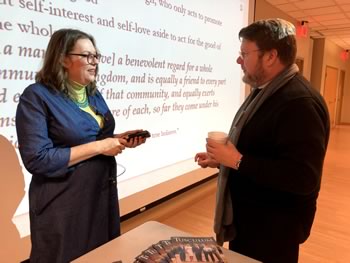
Dollie Boyd, Tusculum University’s director of museums, speaks with Father Ken Saunders, rector of St. James Episcopal Church in Greeneville, during a break at the Feb. 19 Theologian-In-Residence presentation.

For example, take Hezekiah Balch and Samuel Doak, the respective founders of Greeneville College and Tusculum Academy, which are the predecessors of what is known today as Tusculum University. The two enjoyed a common bond as fellow Presbyterian ministers and experienced many years of harmony together, but Dollie Boyd, Tusculum’s director of museums, recently explained how they often did not see eye to eye.

Boyd shared these stories during the third presentation of the 2019 Theologian-In-Residence lecture series, held Tuesday, Feb. 19, in the Chalmers Conference Center of the Scott M. Niswonger Commons on Tusculum’s Greeneville campus. The four-part series will conclude with another lecture by Boyd from 10 a.m.-12:30 p.m. Tuesday, Feb. 26, in Chalmers.

Among the aspects of life Balch and Doak shared were degrees from Princeton University and receipt of their license as ministers in their 20s. They also arrived during the Revolutionary War era to serve in the Hanover Presbytery in North Carolina, which also covered most of Virginia and the populated parts of Tennessee. In addition, they understood the challenges of ministering in a part of the country that posed travel difficulties and had a population that was not easy to categorize.

“Faced with these physical and emotional obstacles, Doak and Balch began as allies in common cause,” Boyd said. “Doak settled in Limestone in 1780. There, he established Salem Church, built a log cabin school and then went on to help establish three other churches – New Providence, Carter’s Valley and Mount Bethel.

“Balch came to Greeneville in 1782 or 1783 and took up the ministry at Mt. Bethel Church, for which Samuel Doak periodically served as minister. Samuel Doak and Hezekiah Balch formally organized the church in 1783 near the big spring in Greeneville. Rev. Doak must have found Rev. Balch a worthy minister to entrust him with the congregation he had started to organize in 1780.”

The two men experienced their first major difference of opinion during the creation of the State of Franklin (now Northeast Tennessee) in 1784. They agreed about the need to establish a state independent from North Carolina, but their viewpoints diverged with the details, Boyd said.

“When the issue of schools came before the organizers, Doak proposed a clause in the constitution that would establish ‘one university, which shall be near the center of the state and not in a city or town,’ a move which Balch perceived as an effort by Doak to have his academy become the recipient of government largess,” she said. “Controversy ensued, with bitter feelings erupting on just what form the new government should take.”

Boyd said Balch went to an extreme by burning an opposition leader in effigy. But when the State of Franklin ended in 1789, the disagreement between him and Doak appears to have dissipated, she said. The two clergy members then collaborated with Charles Cummings to establish a Presbytery in the region, which grew to include 36 congregations in just 12 years.

As they worked together, they demonstrated different personalities. Boyd shared a story how Balch, Doak and some elders from the Presbytery, after praying, proceeded to license a minister even though several other eligible voters were not present. The group knew they would have to justify their actions at the Synod, and the following exchange between Balch and Doak occurred, according to members of the Doak family.

“Balch said, ‘Brother Doak, we will get on the good side of the doctors drinking wine with them so as to make our censure as light as possible,’” the Doak family said. “Doak responded, ‘The harvest is ripe, and the people are thirsting for the gospel. We need the services of that young man. We did what was right, and I will fight it on that line.’”

It is unclear what final approach they took, but church leaders forgave them and upheld the granting of the license.

In about 1786, Balch and Doak also partnered to advocate for replacing Francis Rous’ psalms sung in worship services with those of Isaac Watts. They succeeded, with Watts’ versions becoming the accepted version at the 1786 Abingdon Presbytery meeting.

However, their relationship was about to cool significantly, and it centered primarily on Balch’s exposure to the philosophy of a fellow minister, Samuel Hopkins. Balch had been encouraged to seek out Hopkins’ followers when he made a trip to New England in 1795 to raise funds for Greeneville College.

“His encounter with Hopkins’ ideas was no accident,” Boyd said. “For quite a while, he had been seeking more enlightenment on doctrines. In Hopkins, he found the man who could answer for the spiritual need he felt.”

Boyd said Hopkins’ belief system is a moderate Calvinist theology. She said Hopkins developed his philosophy from the ideas of renowned revivalist and theologian Jonathan Edwards who was a mentor, friend and colleague.

“Enlightenment ideas and terminology informed Hopkins’ work,” Boyd said. “He applied rational thought and logic to construct a response to the problem of sin in the world and as a counterpoint to social forces like materialism, secularism and deism. He looked around him and saw these harmful ideas on the rise in the new Republic.”

She said Hopkins believed God not only permits, but also wills, sin to exist so the world can see the full extent of God’s grace and power to punish the wicked. He advocated for emancipation and preached against slavery from the pulpit, receiving a mixed response. Hopkins also argued in a Knoxville Gazette letter for love of Africans, Cherokees, Roman Catholics as well as Quakers, Methodists, Baptists and “even for the Presbyterians.”

“These were the heretical ideas that brought Balch before the Presbytery 16 times, called before the Synod four times and before the General Assembly once,” Boyd said. “He made it through all of these church trials with his license to preach intact, but the personal cost was very high.”

When he returned to the area and explained what happened at the Synod, his local opponents accused him of downplaying his censure, and Mt. Bethel’s doors were closed to him. He dealt with that by preaching to supporters under the trees near the graveyard. However, his troubles continued, with members of the Union Presbytery filing several charges against him. The Synod of the Carolinas dismissed most of the charges in 1799 but suspended him and forced him to wait for the Presbytery to agree to reinstate his license.

“After his suspension, the division in Mt. Bethel was irreparable,” Boyd said. “The anti-Balch faction split off, taking the name Mt. Bethel, and the pro-Balch side kept the church building and renamed it, perhaps with a touch of longing if not irony, Harmony Church.

“At this time, both Abingdon and Union Presbyteries claimed overlapping territory in Greeneville. In a move to clear up confusion, they redrew the line, placing the newly founded Harmony Church back in the Abingdon Presbytery, a body populated with a fair number of his detractors like Samuel Doak. He refused to attend what he viewed as a hostile body and was promptly suspended by Abingdon as well.”

Boyd detailed another incident from sometime in the 1790s that showed the testiness between Doak and Balch. When the two men met on a muddy street in Greeneville, there was room for only one man to walk across a particularly impassable section on a plan. Doak said, “I never make way for the devil.” Balch said, “I do” and stepped aside for Doak to pass.

As difficult as the period with the presbyteries and synods and subsequent years were for Balch, a bright spot emerged. Charles Coffin, a minister who Balch had met during his 1795 trip, came to this region at Balch’s invitation and made a positive difference, particularly with Greeneville College.

“Coffin’s nearly four years spent fundraising helped save the school by making it possible for Greeneville College to build structures and acquire a library large enough to truly begin operation,” Boyd said. “Some of the money came with big strings attached, however.

“Several prominent New England Hopkins adherents gave generously to the fledgling school on the condition that it would follow Hopkinsian doctrines and hire only instructors who adhered to his doctrines. The Board of Trustees balked at this restriction, and it was Coffin who engineered a compromise that appeased the trustees while letting them keep the donations.”

Coffin became a beloved minister and teacher who succeeded Balch as president of Greeneville College, serving from 1810-1827.

Greeneville College and Tusculum Academy merged to become Greeneville and Tusculum College and later Tusculum College and Tusculum University. Boyd conjectures Balch and Doak would not have supported the merger given their poor relationship in the later stages. But she cites an 1880 speech by a Doak descendant that praised Balch, 70 years after his death.

“It’s nice to think that the merger of Greeneville and Tusculum helped heal a rift that drove two men apart and divided the community,” Boyd said.

Boyd’s Feb. 26 lecture is called “The Role of Presbyterians in the Education of Women in the 19th Century.” To reserve a seat and receive lunch in the Tusculum cafeteria afterward, please call the Institutional Advancement office at 423-636-7303 or email kkidwell@tusculum.edu. The session and meal are free, but Tusculum appreciates donations.