


GREENEVILLE – An archaeology professor at The Hebrew University in Jerusalem will return to Tusculum University to deliver another public presentation, this one delving into biblical kings.
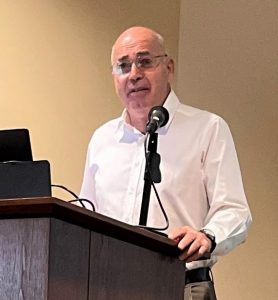
Dr. Yosef “Yossi” Garfinkel speaks at Tusculum in 2022.
Dr. Yosef “Yossi” Garfinkel will deliver his lecture “Searching for the First Biblical Kings of Jerusalem: David, Solomon and Rehoboam” Monday, Sept. 15, at 6 p.m. in the Dr. Nancy B. Moody Lecture Hall in the Meen Center. His talk comes three years since his last appearance at the university, when he discussed Lachish, one of the most famous Israeli sites with connections to all parts of the ancient near East and the biblical tradition.
“We are honored to host Dr. Garfinkel again and to learn about recent archaeological finds that inform our understanding of Israel during the biblical period,” said Dr. Scott Hummel, Tusculum’s president and a friend of the archaeologist. “Dr. Garfinkel delivered an insightful lecture during his first appearance, and his upcoming presentation will be just as informative and stimulating. People will come away with a greater appreciation and knowledge of ancient Israel and the Bible.”
Dr. Garfinkel has been the lead archaeologist at Khirbet Qeiyafa and Tel Lachish. These excavations have revealed new evidence for the time period associated with Kings David, Solomon and Rehoboam. This work has provided valuable insight into the condition of Israelite society at that time, including its religion, economy and political development.
Tusculum has a special connection with Dr. Garfinkel and his work at Tel Lachish. Tel Lachish is the site where the ruins of the ancient Canaanite and Judean cities of Lachish are located. Because it was the second largest city in ancient Judea, second only to Jerusalem, and because it has not been occupied since 150 BC, it is one of the best-preserved sites in Israel.
In 2023, a Tusculum alumnus, Eirik Dahlgren, and two students, David Bowlin and Hughston Burnheimer, spent three weeks participating in the excavation at Tel Lachish. Bowlin and Burnheimer have since graduated.
Garfinkel is the Yigael Yadin Chair in Archaeology of Israel and a professor at the Institute of Archaeology in the Biblical Department at the Hebrew University of Jerusalem. Since 2007 he has concentrated his research on the early, heavily debated phases of the Kingdom of Judah in the 10th and 9th centuries Before Common Era.
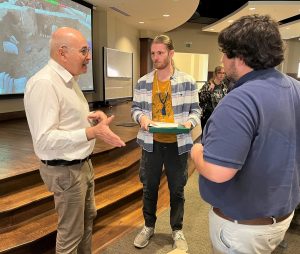
Dr. Yosef “Yossi” Garfinkel, left, speaks with Eirik Dahlgren, middle, and Hughston Burnheimer at the conclusion of his 2022 lecture. Dahlgren and Burnheimer were students at the time but have since graduated.
He has authored 33 books and about 200 articles. His research interests are the Neolithic period of the Near East, the history of dance, the Chalcolithic period and the biblical kingdom of Judah.
Previewing his upcoming talk, Dr. Garfinkel said recent discoveries in Israel, particularly those found at his excavations at Khirbet Qeiyafa and Tel Lachish, have significantly informed the scholarly debate about the date and nature of the early monarchial period of the Kingdom of Judah.
Before these discoveries, some minimalist theories challenged the historicity of David and Solomon and argued the Judean kingdom did not emerge until several centuries after the biblical material suggests.
“At Tel Lachish, a well-planned and fortified city was discovered, with public buildings, administration and inscriptions,” he said. “It has been radiometrically dated to the early 10th century BCE, the time of King David. It is clear that during David’s time, the transition from a tribal rural society to an urban society and a kingdom took place.”
In addition, he said, a stone box resembling a miniature structure was discovered at Khorbat Qayafa. The structure fits the biblical description of Solomon’s palace and temple and indicates that the royal construction described in the Bible in the 10th century BCE was known in Judah at that time.
“In the excavations at Lachish, a previously unknown city wall was found in the earliest city of the Kingdom of Judah,” Dr. Garfinkel said. “Radiometric dating placed the construction of the city at around 930 BCE. This fits the biblical tradition that King Rehoboam fortified Lachish.”
Dr. Garfinkel’s lecture is free and open to the community, but donations are welcome. To learn more about the university, please visit www.tusculum.edu.