


GREENEVILLE – Seniors studying in the natural sciences at Tusculum University have taken another step in their career preparation by presenting their capstone research projects to faculty members and fellow students.
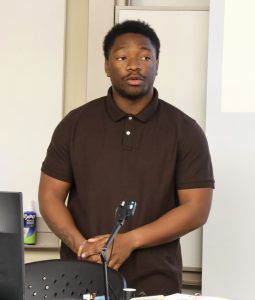
Joaquin Graham discusses his research on microplastics.
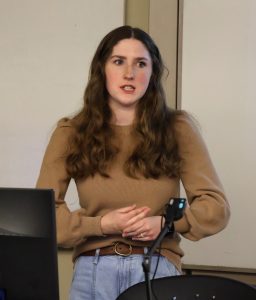
Katie Campbell shares her knowledge during her presentation.
Fourteen students recently spent about 15 minutes each in the state-of-the-art Meen Center sharing details about their research and answering questions. The presentations were the last component of a two-course seminar series that gives students the tools to discuss a topic in a way the average lay person would understand.
Having completed the process, these students are readier to enter the job market or pursue a higher level of education in a graduate school or professional program, such as medical school. Dr. Susan Monteleone, professor of biology, who organized the presentations, praised the students in her room.
“They did an incredible job,” she said. “They were informative, professional and poised, and they enjoyed teaching others about what they had learned. You saw that in their mannerisms and their ability to present themselves and the subjects they researched. I enjoyed watching them present their subjects.”
Dr. Chuck Pearson, assistant dean of the Math and Science Division, also commended the students who presented their research in his room.
“Every student in that room has shown substantial development of their scientific thinking and their confidence in professional presentation during their studies at Tusculum,” he said. “I see the signs of progress in every one of them, and that gives me a great deal of pride.”
Student perspectives
Kiera Taylor is seeking a bachelor’s degree in biology and a minor in psychology, with plans to become a physician assistant in obstetrics and gynecology. Her presentation was “Ethical and Socioeconomic Considerations in Home Birth versus Hospital Birth.” She sees a correlation between her capstone project and her career plan.
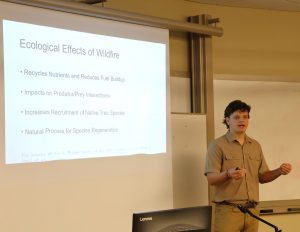
Caleb Swinehart presents his subject.
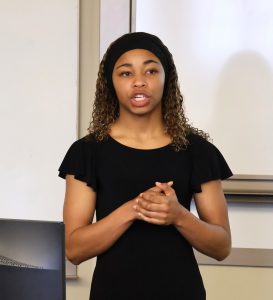
Kiera Taylor gives her presentation.
“One of the topics I listed during my presentation was the relationship between the patient and the medical professional,” Taylor said. “Because I would like to become a medical professional, this research is going to help me learn ways to improve my relationship-making skills. I don’t want to be a professional that’s there to do only the work. I want to be someone that my patients can confide in and trust. Having that trusting relationship is something that I really want to focus on building during my career.”
Caleb Swinehart is pursuing a bachelor’s in environmental science. His desired career involves working in the outdoors, potentially with the U.S. Forest Service or in some sort of conservation job in a forest environment. The name of his presentation was “Wildfire and Prescribed Fire Ecology: Wildlife, Habitat and People.”
“This presentation has helped a lot – just going through the literature and understanding what people are studying in this field and how they go about their study,” Swinehart said. “Through the process, I have learned what it takes to read and digest that information and understand that material and then to expand upon it and take it your own way.”
Swinehart completed research papers in high school but said the presentation he gave for his capstone was much more in depth.
“You have to know the material to be able to give a talk about it,” he said. “Most people in here don’t know much, if anything, about the topic. You also have to be prepared for the questions and really invest yourself into knowing the science and enjoying the science so it’s not a burden to go and research.”
Taylor had similar thoughts.
“Coming from high school, I didn’t have as deep of an understanding of how to research and what to research,” she said. “At Tusculum, I’ve learned how to break apart the process of going through research papers and building something like this presentation. I’m able to use the information that I’ve gathered to actually explain my topic and how it relates to my life.”
Thoughts from professors
Dr. Monteleone said the senior capstone is a major moment for students in their studies.
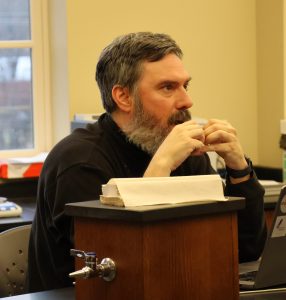
Dr. Chuck Pearson asks a question.
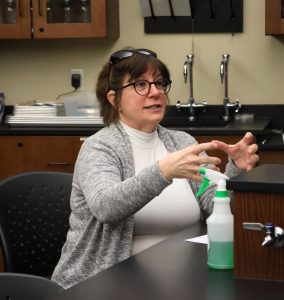
Dr. Susan Monteleone contributes to the discussion during one of the presentations.
“It’s a culmination of their educational experiences, and it’s their opportunity to stretch those intellectual muscles and share their excitement over something they’ve spent time researching and learning about,” she said. “It also gives them a way to show themselves as professionals in a safe environment among their peers and faculty members. They have the opportunity to grow more in a professional manner.”
She also described the hard skills this event provides for the students.
“It demonstrates their growth in communicating science – their ability to organize information that they have been gathering, reading and thinking about into a cohesive presentation,” Dr. Monteleone said. “It expands their boundaries beyond their comfort level, giving them a new horizon they can engage in. Maybe this experience will make it easier for them to say, ‘I might go to a symposium and present my work. I might develop a poster and stand in front of it and defend it with people who come by.’”
Dr. Pearson agreed.
“One of the hopes that you have in a program of this sort is that students are capable of speaking at a moment’s notice and with deep, deep preparation at other times in front of peers and superiors and communicate technical information with confidence and clarity. We need talented scientific communicators in society.”
Dr. Monteleone also said the capstone presentation helps students develop skills they might need to include on their résumé or a job application. She said the experience makes them more well-rounded candidates for a job, graduate school or professional school.
People can see a list of the topics the students discussed at https://www3.tusculum.edu/news/tusc-family/2025/2025-natural-sciences-senior-capstone-presentations/. More information about the university’s natural sciences programs is available at www.tusculum.edu.