


GREENEVILLE – Tusculum University leaders and students shared what makes the higher education institution special as prospective students explored all that is available on campus during an open house Saturday, March 28.
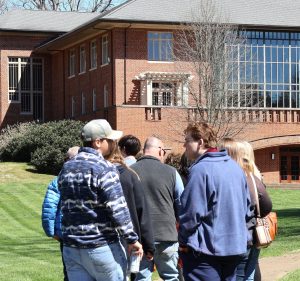
Some of the attendees took the campus tour and approach the Thomas J. Garland Library.
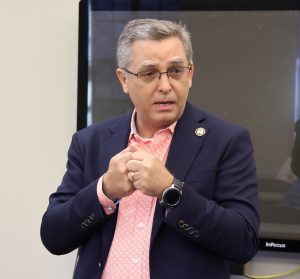
Dr. Scott Hummel speaks with prospective students at the open house.
Dr. Scott Hummel, Tusculum’s president, noted that providing students access to college is important to the university, but he said the institution places even more emphasis on helping its Pioneers attain graduation.
“We want you to start college, we want to support you through college and we want to see you walk across the stage,” he said. “You’re going to find a whole lot of support to help you get across that finish line.”
A mission that serves students
Dr. Hummel highlighted how Tusculum’s mission produces growth in its students during their studies. He noted that students will become even better citizens because of the value Tusculum places on being civically engaged. That happens through classic activities such as community service, but it also occurs through people listening to each other and speaking with individuals who have different ideas and approaches.
The university also enriches students’ lives and helps them be good spouses and strong thinkers and analysts after graduation.
One of the outcomes for every graduate is to be career-ready, and Tusculum takes a three-pronged approach to equipping students for their professional jobs after graduation. The first is to give them the technical knowledge – the hard skills – to perform their work. Another component is to learn the soft skills – listening, collaborating, de-escalating tense situations and showing up on time. Then there are the character skills, such as learning to do the right things the right way.
“To be career-ready, you need to have all three of those skills,” Dr. Hummel said. “Through your classes, your interactions with a variety of people and the campus life experience, you’re going to be prepared for those outcomes.”
Dr. Hummel said Tusculum’s caring Christian environment demonstrates the way the university values each student regardless of the belief system each person holds. But he also emphasized that Tusculum’s Christian approach to education means students not only can discuss and explore different academic subjects but also converse about and delve into their faith. Additionally, it means students are encouraged to examine their calling and purpose and not limit their self-discovery process as part of their studies.
The academic experience
Another key part of Tusculum’s mission is the university’s active and experiential approach to education, which means that students not only receive valuable instruction in the classroom but also find ways to put that knowledge into practice. That includes conducting research, obtaining internship and connecting with the community. One of the newer examples for Tusculum students is the work by students in four academic programs – art and design, computer science, English and history – to create a website for USS Greeneville Inc., a local organization that supports the U.S. Navy ship of the same name.
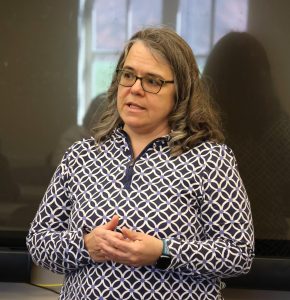
Dr. Heather Henson-Ramsey shares academic information with the audience.
Dr. Heather Henson-Ramsey, assistant vice president of academic affairs, cited the university’s participation in the Volunteer Income Tax Assistance program. Students are trained by Dr. Harold Branstrator, associate professor of management, to prepare income tax returns for free for community members who qualify. Students and community volunteers prepare tax returns at three sites in Northeast Tennessee and have completed more than 1,000 in each of the last two years.
Dr. Henson-Ramsey touted ways students benefit academically during their studies. Students have the opportunity to develop their own businesses; create websites for companies; and present at local, national and international conferences. Faculty in the Education Division help their students understand fully what it means to be a teacher and how they can be successful in that profession.
Dr. Henson-Ramsey, who also teaches anatomy classes, emphasized the connections faculty members develop with their students. She said faculty members mean what they say when they tell a student to visit their office to discuss their coursework or to email and call them.
“I find that building relationships with students from the beginning through graduation is incredibly gratifying,” she said. “It’s so nice to get to know individuals and what their goals are and to help them on their path.”
A student’s perspective
Senior Janelle Zirger, who serves as president of the Student Government Association, is pursuing a bachelor’s degree in criminal justice and a minor in psychology. She has built an extensive portfolio of activities in which she participates and leadership positions she holds, including being a member of the President’s Society and serving as a Pioneer Peer, a tutor and a mentor in the Student Support Services program.
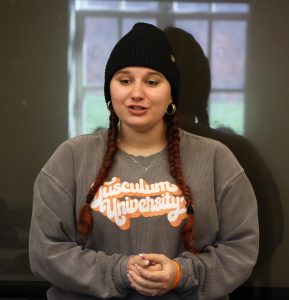
Janelle Zirger talks about her student experience.
SSS works with Pioneers whose parents do not have a bachelor’s degree, who meet income eligibility requirements and who have disabilities. Zirger is a first-generation student, like more than half of the others enrolled at Tusculum.
Zirger next plans to enter graduate school, and she said the options she has are due to the scholarships, internships and relationships she cultivated at Tusculum.
“Throughout my four years, I’ve done a lot of discovering not only what I want to do with my future but also discovering myself,” she said. “That’s not possible without working with people like this every single day and being able to talk with them and other students on campus.”
Zack Kassebaum, vice president of enrollment management and financial aid, asked Zirger to speak because he found her story compelling. He commended her hard work and called her a great example of what Tusculum produces. He said she has taken advantage of Tusculum being a smaller university with a lot of opportunities for students who do not have to wait their turn.
Paying for college and the student experience
During the event, prospective students had the opportunity to speak with Melissa White, director of financial aid, who leads a team that helps make Tusculum affordable. When she spoke with the audience, she highlighted the variety of institutional, federal and state aid available to students, including competitive academic scholarships.
One of the many ways Tusculum helps is through the Pioneer 100 program, which enables students who are eligible for the HOPE scholarship, qualify for a full Pell grant and submit their FAFSA by Feb. 1 to go to Tusculum tuition free. Students who complete their FAFSA after Feb. 1 might still be eligible, but it is not guaranteed.
Scholarships are also available through SSS.
White reminded students of the importance of completing their FAFSA, which helps determine the amount of aid they can receive. She said her office would be happy to work with people to complete that form.
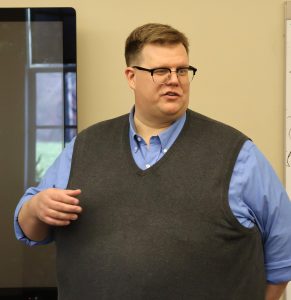
Zack Kassebaum speaks at the open house.
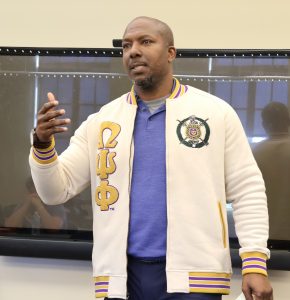
Chuck Sutton shares information about campus life.
Chuck Sutton, vice president of student affairs and retention, told the audience about his office’s open-door policy and the bonds he and his staff develop with students. He said the office emphasizes personal growth and mixes that with accountability. He also talked about the opportunity for students to become resident assistants, which allows them to be mentors for their classmates who lives in the same residence hall.
Sutton referenced the many areas Student Affairs handles, such as housing, clubs, intramurals and free counseling. He shared that his office coordinates the response when it is notified about students who might be experiencing difficulties.
“We enjoyed speaking with prospective students and their families about their aspirations,” Kassebaum said. “For those who have settled on Tusculum as their preferred choice, we are grateful and look forward to helping them finish the process to become students. For others who are still considering their options, we are glad they joined us and are pleased we were able to start a conversation with them about their goals. Our admission team is always ready to talk and assist in the decision-making process.”
More information about the university is available at www.tusculum.edu. To apply, please visit, https://site.tusculum.edu/apply-visit/apply/.