


GREENEVILLE – Tusculum University expressed its gratitude at a recent dinner held for donors who have helped make a college degree possible for students through their gifts for scholarships.
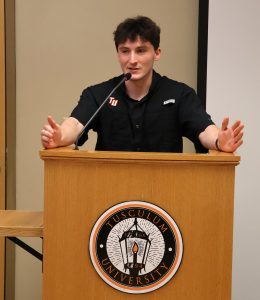
Tusculum student Rio Little discusses how scholarships have helped him focus on developing himself instead of worrying about finances.
The Office of Institutional Advancement held its Pioneer Promise Scholarship Dinner in Chalmers Conference Center. Donors heard about the value of scholarships from Tusculum junior Rio Little, who is a sport science major, as well as messages about the importance of giving from Dr. Scott Hummel, the university’s president, and Edward Roberts, vice president of institutional advancement.
Scholarships are a key component of a new fundraising campaign Tusculum has launched.
“Those who have donated for scholarships have transformed students’ lives,” Dr. Hummel said. “When they contribute for scholarships and other needs, they are giving students access to an active and experiential education in a caring Christian environment that prepares them to be career-ready, civically engaged professionals. This vital financial support makes graduation possible, empowers students to achieve their dreams and strengthens the workforce and communities.”
Little moved to Greene County in 2015 and gained his initial exposure to Tusculum through the soccer camp of Mike Joy, the former coach of the university’s women’s soccer team. As a student at Chuckey-Doak High School, he received a scholarship to play football at Tusculum and other schools. When he evaluated the offers, Tusculum was the best one for him financially. He has also received academic scholarships.
Because of the scholarships, Little has been able to focus on his education, grow his leadership skills, participate in service activities and play football instead of worrying about finding the money for his studies. In addition to playing defensive back and on special teams with the football team, he served a resident assistant in the residence halls and is now a peer mentor for the new Discipleship Living-Learning Center.
“To people who have donated to these programs or donated to the school that have allowed me to be in this position, thank you so much,” Little said. “I appreciate all of the support that you have provided me and many other students. Your donations are doing a lot more than what it looks like on the surface.”
Little noted that he is witnessing a Christian revival on campus, with students taking more initiative in their spiritual walks and showing more interest in ministry activities.
“I just want to provide eyewitness testimony to it all that because of the financial freedom that I have had, I’ve been able to contribute to that new direction,” he said. “This is especially the case through the Discipleship Living-Learning Center.”
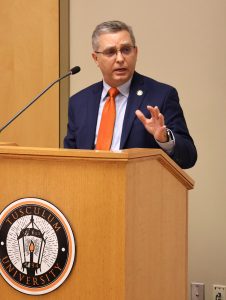
Dr. Scott Hummel discussed the importance of gap scholarships.
Dr. Hummel impressed on attendees that they can particularly help students by funding gap scholarships at the university. Those scholarships provide the remaining dollars for students after they have received other financial assistance. For many students such a scholarship can make the difference between being able to attend Tusculum or having to put their college education on hold.
Because 58 percent of Tusculum students come from families whose parents do not have a bachelor’s degree and half of the students come from low-income households, funds to attend the university can be limited for these Pioneers. Gap scholarships can be a solution for these students.
“When we look at how much gap scholarships can leverage potentially in Pell Grant or state funds, the amount is about four to one,” Dr. Hummel said. “About every dollar someone gives for a gap scholarship generates about four additional dollars. That’s a good financial investment in that student, who is now able to attend Tusculum.”
Scholarships are a key component of the Frontiers fundraising campaign, which entered the public phase in November. Frontiers is a four-year campaign with a goal to raise $13.5 million. Tusculum is seeking $8 million for scholarship support. So far, Tusculum has raised in the $1.3 million in the silent and public phases toward that goal, Roberts said. That announcement brought applause from the audience.
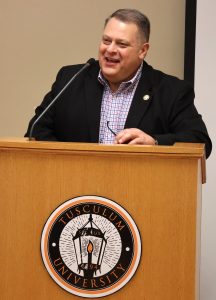
Edward Roberts emphasized the impact of scholarships.
Roberts reinforced the value of donations for scholarships.
“Scholarships help young men and women get their feet under them and grow as individuals,” he said. “That support has an impact not only on our community but also on our nation.”
In addition to scholarships, the campaign seeks $4.5 million to enhance the student experience further and $1 million for future projects and programs. Programs and facilities that will benefit from additional dollars for student experience include campus ministries, the Center for the Arts, the Center for Civic Advancement, club sports, the Honors Program and the Wellness Center. The campaign also will benefit the Thomas J. Garland Library.
Future projects include more initiatives with the Christian Leadership Institute, which is the umbrella for multiple faith-based programs and events at the university, including the Discipleship Living-Learning Center; the Center for Free Enterprise and New Venture Creation; and new master’s degrees.
People who are interested in donating to the campaign can visit www.tusculum.edu/giving and select the Frontiers campaign in the drop-down menu.
Dr. Hummel told the dinner attendees that he recently had dinner in Atlanta with three alumni – Mason Bierster, Carmen Brown and Tariq Jenkins. He said they had a unified message.
“All three very much emphasized that their Tusculum experience prepared them for the place they are now in life,” he said. “They talked about more than just their major and minor. They also discussed their overall experience at Tusculum. Two of them were student-athletes, who bragged on their professors and highlighted how playing sports gave them valuable skills with time management and being part of a team.”
Dr. Hummel emphasized that the university is meeting its mission, which the Board of Trustees recently reaffirmed, in impressive ways. For example, he said the brochure for the Frontiers campaign was designed by student Jaida Ellison and noted that Tusculum students will create a website for USS Greeneville Inc., which supports the Navy ship by the same name and the personnel who serve on it. Both of these are part of the active and experiential learning Tusculum provides.
He said the caring Christian environment element of Tusculum’s mission was on full display in December in response to the passing of freshman Payton Cook in a car accident near campus. Dr. Hummel noted that the Tusculum family rallied around each other in that moment, and he was proud to witness that togetherness.
“As I look out at the dinner audience, I see a number of people who have hired many employees,” Dr. Hummel said. “You need people who are smart, but you also need people who are good for your organization. And you need people who have the character skills to do the right things the right way. I am proud that we are graduating those types of individuals.”
More information about the university is available at www.tusculum.edu.