


GREENEVILLE – Anyone who has visited Tusculum University has commented on the campus’ beauty.
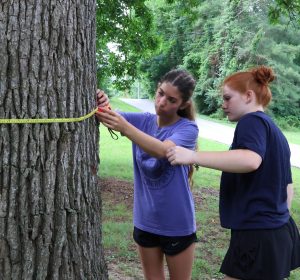
Two students measure a tree in Tusculum’s arboretum.
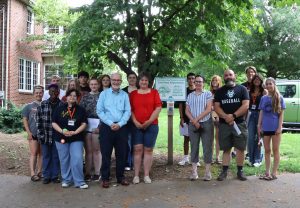
Tusculum administrators and faculty are joined by students in the Upward Bound and Upward Bound Math and Science Summer Academy to celebrate the recertification.
One of the attractive elements of the historic campus is the abundance and variety of trees that give students, faculty, staff and guests plenty of enjoyment while they are on the grounds. Tusculum is home to a Level I arboretum, which encompasses the whole campus and includes 36 species, most of which are native to East Tennessee.
Recently, Tusculum celebrated the news that the Tennessee Urban Forestry Council has recertified the university’s arboretum at Level 1 through 2030. In addition to Tusculum leaders and faculty showcasing the updated sign, participants in the Upward Bound and Upward Bound Math and Science Summer Academy at Tusculum measured trees within the arboretum to collect beneficial data.
“We are excited to see our high-quality arboretum recognized again for its variety of trees and its contributions to the community’s quality of life,” said Dr. Amiel Jarstfer, associate vice president for academic innovation and dean of the School of Arts and Sciences at Tusculum. “Our entire campus serves as an environmental laboratory, enabling our students, others in the Tusculum family and community members to study and learn more about nature. We are proud to house such an asset because of the benefits it provides everyone.”
One of the trees in the arboretum is the iconic Old Oak Tree, which is next to the Old College building and near the Thomas J. Garland Library and is estimated to be 250-300 years old and measures 273 inches in circumference and is 102 feet high.
When that tree was recognized as the oldest and largest tree in the state about 10 years ago, Kim Carter, science laboratory assistant, chemical hygiene officer and Environmental Protection Agency coordinator for the university, learned about the potential for Tusculum to have an arboretum. Carter collaborated with others to have the university classified as an arboretum in 2015.
“From a scientific standpoint, the arboretum provides the impetus for students and others to look at the trees,” she said. “For example, students from nearby Doak Elementary School can come here, learn more about the trees and incorporate that into the classroom. Students from other schools are encouraged to discover more about the trees on our campus.”
Carter said the arboretum brings prestige to the university and is a nice complement to the Paul E. Hayden Wetlands located on the edge of campus near the university’s nature trail. For people who like to take nature walks, a visit to the arboretum provides an excellent way for them to understand more about the trees on campus.
Dr. Melissa Burt, assistant professor of environmental science, has similar feelings about the arboretum’s value.
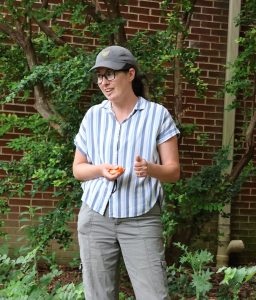
Dr. Melissa Burt teaches students about trees.
“It provides a way for us to showcase the natural diversity that we have on campus,” she said. “It’s also a good teaching tool because we have labeled all of the trees in the arboretum so students and others can see what species we have on campus. The arboretum is also an excellent research outlet because we’re collecting data each semester on these trees in our Introduction to Environmental Science class. We are developing a long-term data set that shows how these trees are growing over time and can be plugged into other types of data during the research process.”
One of the benefits of the arboretum for Tusculum students is its contribution to active and experiential learning, a key component of the university’s mission. They measure the trees themselves and use that information to calculate each one’s biomass and develop the skill of identifying species. They look at the trees and see the differences in the species.
“Because these trees are on campus, it’s really accessible for our students,” Dr. Burt said. “They don’t have to travel far to conduct high-caliber undergraduate research that prepares them for their careers. It’s right here in their backyard on campus.”
Besides measurements that are taking place today, Tusculum has data from maps in the 1940s that gave the size of trees. That is giving the university the ability to examine how fast the trees are growing over time and determine how environmental factors are impacting them.
Carter said Tusculum will conduct further review of the trees to see whether it finds another 24 so the university can achieve a Level II arboretum when the next recertification arrives.
To learn more about the arboretum and see the most current map, please visit https://web.tusculum.edu/academics/arboretum/. Additional information about the university is available at www.tusculum.edu.