


GREENEVILLE – Leaders and advisors in Tusculum University’s Upward Bound and Upward Bound Math and Science programs are helping high school students in those programs put their best foot forward when they complete their résumé and participate in an interview.
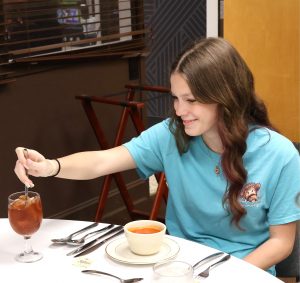
A student practices the best way to stir tea to which sugar has been added.
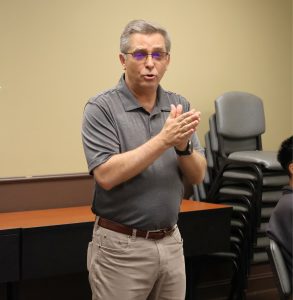
Dr. Scott Hummel speaks with the students.
Upward Bound and Upward Bound Math and Science, which are part of the federal TRIO programs, held sessions Saturday, April 11, on interview skills and résumé-building in the Meen Center. Additionally, students learned the finer points about dining and interacting with others in an eating establishment through an etiquette session in Tusculum’s cafeteria.
Dr. Scott Hummel, Tusculum’s president, who visited the group during the etiquette session, highlighted the value of making a positive first impression. He also commended the students for attending the sessions.
“I think it speaks highly of you to be involved in TRIO programs and to be participating in these activities on a Saturday,” he said. “Folks like you who do extra things like this tend to get ahead and accomplish more later in life. I’m so proud of you for being a part of this.”
Upward Bound and Upward Bound Math and Science as well as the other TRIO programs serve students whose parents or guardians have not earned a bachelor’s degree and who meet income-eligibility guidelines. They are funded through grants from the federal government. Upward Bound and Upward Bound Math and Science serves students in high school.
During the day’s events, staff members from the two programs provided tips for constructing a résumé and being successful in an interview. Then, Dean Zoch, general manager of the university’s dining service, gave students a tutorial about the best way to handle an interview or meeting at a restaurant. The overarching idea was to help students prepare for college and life afterward.
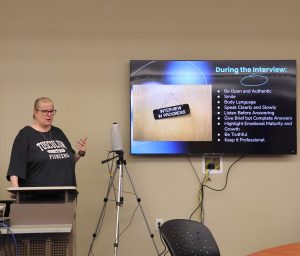
Stacey McGill provides tips interview tips to students.
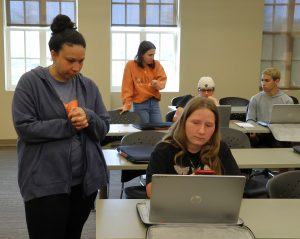
Erin Goins, left, and Kassidy Babler, second from left, work on résumés with students.
Kassidy Babler, director of Upward Bound, led the session on résumés with assistance from Erin Goins, an academic advisor for students from Cocke and Hawkins counties. She said the purpose was to give students working knowledge about what a résumé entails, what employers are seeking in the document and what colleges and graduates expect.
She emphasized to the students that their résumé will continue to evolve throughout their life – that they will never be complete with this document. Babler also provided practical guidance on résumé construction – using strong verbs and active voice, being consistent throughout the document and checking for spelling errors. She even spoke about appropriate font size.
“A lot of our students are freshmen, so we’re creating those building blocks for them,” Babler said. “As they progress through school, they can continue going into this document they created today to add whatever accomplishments they accumulate. We have some seniors that know they are planning to seek a master’s degree after earning their bachelor’s, so we talk to some of them about what they should include in their résumé.”
Stacey McGill, director of Upward Bound Math and Science, led the session on interview skills with input from Aaron Barnett, an academic advisor in that program, and Dr. Catherine Pearson, project director for Upward Bound in Cocke and Hawkins counties. McGill said solid interview skills are essential for students.
“They are so valuable because these students will be in a competitive environment when they are interviewing for a job or a scholarship,” she said. “Sometimes, a student will have several interviews for a job or scholarship, and the first one can determine whether they qualify for a second one or impact the decision by the employer or scholarship committee.”
Among the subjects McGill addressed were conducting research on the potential employer or scholarship and properly dressing for the interview. During the interview, she highlighted the importance of body language, a smile, brief but complete answers and professionalism.
McGill also shared some of the potential types of questions the interviewer might ask, such as strengths and weaknesses, the reason the student is interested in a particular job and his or her future goals. She also noted that some questions might be introspective. They might address a mistake the student has made and the lesson he or she learned from it or the way a person handles a stressful situation. She also told students about the need to follow up after the interview with a note and to be gracious if they do not receive the job.
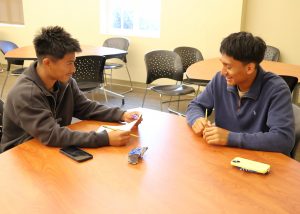
Students conduct practice interviews.
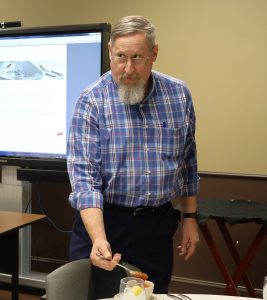
Dean Zoch discusses the best way to manage eating soup.
Zoch’s tips included the way to eat a meal without potential mishaps that could be problematic. He reinforced some of what he shared with a video of examples prior to starting the meat of his discussion.
As an example, he shared the appropriate method for reducing the temperature of the soup besides blowing on it. He discussed the proper format for unfolding a napkin and placing it in one’s lap. He recommended that students not order a dish that is unfamiliar to them to avoid the potential discomfort of not enjoying it. Zoch also urged them not to order foods that are potentially messy.
In addition, Zoch discussed introductions at the meal, saying participants should use first and last names and include titles a person holds and make specific relationships clear.
“Table manners play an important part in making a favorable impression,” he said. “They are visible signals of your manners and, therefore, are essential to professional success.”
Further information about Upward Bound and Upward Bound Math and Science is available at https://site.tusculum.edu/student-success/academic-affairs/first-gen/ub/ and https://site.tusculum.edu/student-success/academic-affairs/first-gen/ubms/, respectively. To learn more about the university, please visit www.tusculum.edu.