


GREENEVILLE – Five weeks of thorough preparation and mentoring by Tusculum University staff members with local high school students participating in a summer program resulted in high-caliber research projects that highlighted their hands-on learning experience.
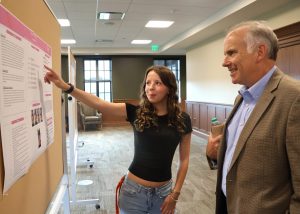
Abagail Taylor, left, discusses her poster with Dr. David Smith.
Upward Bound and Upward Bound Math and Science at Tusculum, which are part of the federal TRIO programs, have concluded the on-campus portion of this year’s Summer Academy at the university. The final element was the presentation by rising sophomores and juniors of posters they had created that summarized the research they had conducted during their time at Tusculum. Judges evaluated their posters.
Additionally, other Upward Bound students who had a theater concentration held a performance in the Marilyn duBrisk Theatre that highlighted the many skills they had developed in the same time period. They learned not only about performing on stage but also about the behind-the-scenes components that yield an excellent, crowd-pleasing production.
The students showcased their academic and performing arts skills during an evening event Wednesday, June 24, in the Meen Center and Annie Hogan Byrd Fine Arts Center.
“Seeing the students share what they have learned during their time on campus brings us great joy,” said Dr. David Smith, executive director of TRIO programs. “Our staff works diligently to create an enriching Summer Academy, filled with active and experiential learning, that helps our students better understand the collegiate atmosphere and be equipped to succeed in it. The students embrace this opportunity and demonstrate at the end how much they have grown in their respective interest areas with outstanding posters and theater presentations.”
The Summer Academy is a six-week program for the high school students. Following their five weeks on campus, the students spend the final week taking an educational trip with staff from the two programs. This year, the students and staff are traveling to the nation’s capital.
Upward Bound and Upward Bound Math and Science students serve students whose parents do not have a bachelor’s degree and who meet income-eligibility requirements. The programs are funded by federal grants.
During the on-campus portion of the academy, all of the high school students attend classes in the morning on a variety of subjects. In the afternoon, rising sophomores and juniors in the Upward Bound and Upward Bound Math and Science programs focus on researching a topic in depth, crafting a poster and preparing to explain it to those who attend their end-of-academy presentations. Meanwhile, other Upward Bound students are taking a deep dive into theater so they can perform for remaining students.
Upward Bound research projects
Meagan Stark, director of Student Support Services, a TRIO program that serves Tusculum students with the same backgrounds as the others, taught the research class for Upward Bound participants. Her students focused on the social sciences, with topics such as social media, COVID, treatment of women in space exploration and barriers to mental health care for veterans.
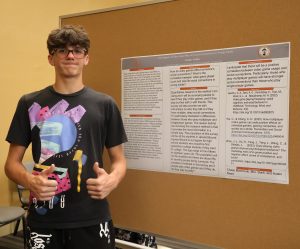
Parkar Collins stands by his poster during the presentations.
The students learned about the methods involved in research, the way to read an academic article and the manner in which others have conducted research before diving into the topic they chose.
“As part of the class, I was teaching them about taking effective notes and turning their thoughts into a product on paper,” Stark said. “It’s really impressive they were able to pull it off in just a month.”
Parkar Collins, a rising sophomore at North Greene High School, presented “The impact of video game play on social connections in young adults.” He entered the project not knowing how to proceed but felt better about it when he received a template and received instruction on the process. As he reflected on the process, he said he had a positive experience.
“When I first started it, I had a pretty tough time understanding it,” Parkar said. “Once I got toward the end, I found that I had a lot of mistakes, and I went back to fix those. That helped me with how I think about things and that they are not as bad as they seem. I discovered that doing this type of research is a lot easier than I thought it would be.”
Upward Bound Math and Science projects
Aaron Barnett, an academic advisor with Upward Bound Math and Science, helped guide students in that program through the research process. He said students have the opportunity to choose from one of about five topics. The students learn the American Psychological Association format for presenting their research, completing a research paper and putting together the poster.
Teaching the students about conducting research is extremely important as they prepare for college, especially if they are interested in math and science careers, Barnett said.
“They get really worried about it when we lay out all of this information at the start of the academy,” he said. “But I always remind them that we’re not trying to cure the common cold or solve world hunger. We’re focused more on the process.”
Among the subjects students addressed were water filtration, magnetic levitation, oil cleanup and browning in apples.
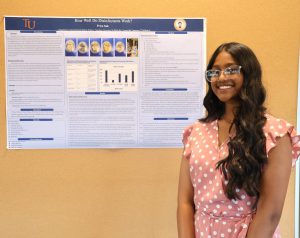
Priya Sah was one of the student researchers during the Summer Academy.
Priya Sah, a rising sophomore at West Greene High School, examined the subject “How well do disinfectants work?” This was the first time she conducted research, and she described it as long but enjoyable.
“I liked that we got to have fun as part of the project,” Priya said. “Not only did we have to sit down and conduct research, but we also got to test how much bacteria there is and work with some of the tools.”
She said the project was easier to manage because a fellow student, Morelia Munoz, was researching the same subject. She also benefited from the assistance of Caleb Hammann, a junior at Tusculum majoring in biology with a pre-medical, dental and veterinary concentration, who served as a teaching assistant. Over time, she found the research to be less intimidating. She now feels well prepared for this type of work in high school and college.
Hammann assisted the students with their experiments, formatted everything and made sure they stayed on track to complete the research project correctly and on time. This was a different approach for him because as a college student, he is accustomed to asking questions instead of answering them. But he liked being in that new role.
“It was very neat and a good experience for the future,” said Hammann, who plans to become a physician. “I enjoyed interacting with people. It was very cool to see them start not knowing anything and by the end being very proud of what they have accomplished. They’re all very excited about that. Watching them go through that was fun. I definitely benefited with my communication skills.”
Upward Bound theater
Erin Schultz, Tusculum’s costume director, said the theater students learned and practiced the improvisation form of comedy. They also developed their skills with monologues and scenes from plays and learned about a variety of techniques used in acting. Additionally, Schultz taught them about stage makeup.
The students were able to absorb the knowledge of several guests, who shared their expertise in theater. One of them is a standup comic who has toured the country and shared about his life on the road and on the stage as well as taught them about the way to write a comedy set.
“What am I hoping the students gain out of this?” Schultz asked. “It’s confidence. If they liked theater, now they know more about it. If they didn’t know anything about theater, now they know whether they liked it. These kids have worked really hard. A lot of them have come out of their shells. It’s always fun to see kids who do not want to get up in front of even their peers at the beginning of the month be super excited to get in front of everybody at the end.”
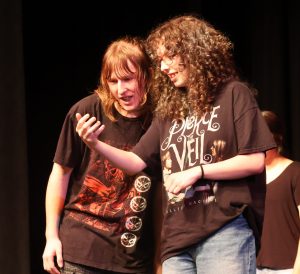
Alyssa Garland, right, performs with Levi Stahl on stage at the Summer Academy.
One of the participants was Alyssa Garland, a rising senior at David Crockett High School. She has been active in the arts throughout her life. She wanted to be part of the theater element of the academy this year because she had heard positive words about Erin Schultz and Steve Schultz, Tusculum’s director of arts outreach.
Alyssa said she has become a better performer, is now less afraid of being on stage and understands the world does not end if she makes a mistake.
“I just love performing for people,” she said. “I love making people laugh. Theater is one of those things where you have a moment to be someone else. It’s cool. I guess you could say it’s an escape experience. All of the people here are really fun. Erin and Steve have taught me a bunch of things. I learned a lot about working lights with Steve, and they gave me really good monologue pointers. I’ve enjoyed getting to know everyone and meet more people with a common interest.”
Further information about Upward Bound and Upward Bound Math and Science is available at https://site.tusculum.edu/student-success/academic-affairs/first-gen/. To learn more about the university, please visit www.tusculum.edu.